Internet Toilet Roll Holder
https://toiletroll.chrisspeed.net
Figure 1. Live feed from the toilet roll holder. Full toilet rolls can be identified as having the highest value up the Y axis, and significant use of the toilet roll can be identified in the drops in data.
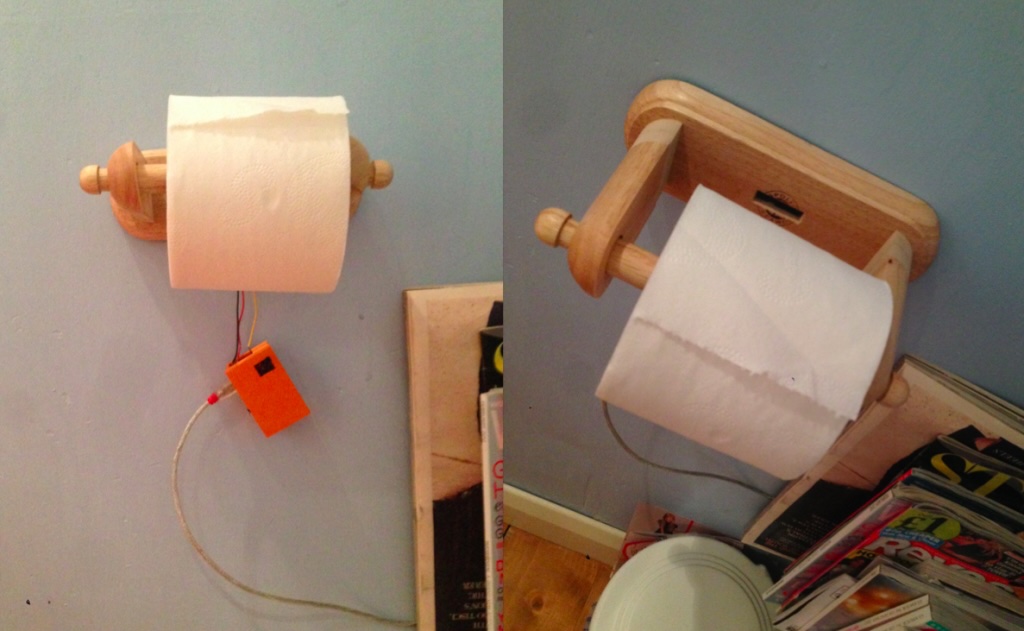
In 2014, my family became part of the Hub of All Things project, which explored how everyday objects could generate personal data. Working with Chris Barker, I helped build an instrumented toilet roll holder using the Electric Imp platform, with an infrared sensor tracking how much paper remained on the roll, streaming live to an online graph.
What started as a seemingly trivial case study quickly became something far more revealing. The data exposed patterns I hadn’t consciously registered in years: when the cleaner visited, when guests used the bathroom, even a child’s runny nose. My eight-year-old daughter’s question—”can it see me on the toilet?”—captured the strange new intimacy of these sensors perfectly.
Living with the toilet roll holder meant renegotiating privacy at home. Visitors needed to be told the downstairs toilet was “online.” I found myself wondering whether to redact data when guests used the bathroom, or hand it back to them on a memory stick.
But there was an upside too: this was data I owned and built myself, unlike the data harvested by free apps in exchange for “terms and conditions.” It hinted at a shift from a Push economy to a Pull economy—where personal data becomes something we control and potentially trade, rather than simply surrender.