What Doesn’t Need To Be New: Two Launches, One Week, One Paradox
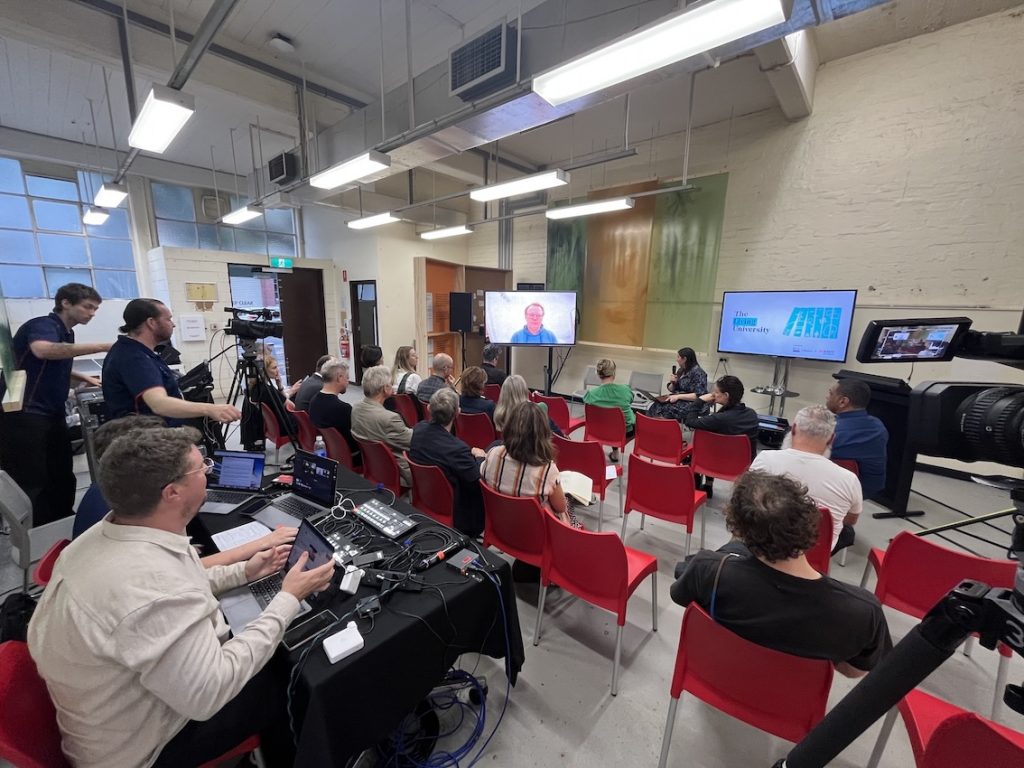
Last week brought two events exploring regenerative futures from very different angles. On one afternoon, I moderated a panel on “Rethinking the Energy Future – From Sustainability to Regeneration” with energy innovators Renée Wootton Tomlin (New Era Energy), Philippa Abbott (Pelagic), and Kate Dundas (UN Global Compact Network Australia). Days later, we launched “The Living University” report – a collaboration between RSA Oceania and RMIT exploring how universities can become catalysts for regenerative transformation.
Both events kept circling back to the same paradox: regeneration isn’t something we need to introduce into our systems, yet our institutional frameworks systematically prevent us from recognising what’s already regenerative. The gap between what we say we value and what our decision-making infrastructures actually reward became impossible to ignore.
The Measurement Problem: What Our Instruments Can’t See
The energy panel concluded with a question from Christopher van der Spek from the Climate Change Authority that cut straight to the heart of the challenge: “If you could measure one thing, what would it be?”
The responses revealed not just what people wanted to measure, but the fundamental inadequacy of measurement itself as currently practiced.
Renée Wootton Tomlin challenged the room: “Is social and environmental capital measured to the same capacity as commercial terms in your organisation’s KPIs?” The question exposed how most institutions create elaborate measurement systems for financial performance while treating social and environmental impacts as secondary, qualitative, hard-to-quantify externalities.
Kate Dundas went further, suggesting we need to “measure human consciousness… can we change our mechanistic materialism thinking pattern into one that’s more quantum and complex?” It was a deliberately provocative answer – how do you quantify consciousness? But the provocation was precisely the point: some of the most important transformations we need can’t be captured in the measurement frameworks we’ve inherited.
Philippa Abbott brought it back to systemic relationships: “How do you measure the relational change or relational value of different parts of the system?” Her question acknowledged that regenerative systems thinking requires understanding connections, feedback loops, emergent properties – precisely what reductionist measurement struggles to capture.
Then came the moment that crystallised the entire conversation. I recalled our 2024 Hackathon with Arup and MAV, where we’d given students 40 datasets with thousands of data points about Melbourne. Halfway through, they came back with a stark observation: “All we’re doing is measuring using the instruments that sustain the development of Melbourne as it is now. They’re great for developers. They’re awful for more than humans.”
The students had identified the core problem: our measurement systems aren’t neutral tools for understanding reality. They’re instruments calibrated to perpetuate particular kinds of value creation – in this case, property development – while systematically rendering other values invisible.

Life is Inherently Regenerative: Daniel Christian Wahl’s Reframing
At the Living University paper launch, Daniel Christian Wahl offered a reframing that completely shifted the conversation. Rather than treating regeneration as something new that universities need to adopt, he anchored it in something much older:
“Life is inherently regenerative. In a living organism, like a university, there’s regeneration going on all the time – acts of caring, sharing, nurturing, collaborating, linking to place, honoring indigenous wisdom, trying to bring service to a larger system. The problem isn’t absence of regeneration but our inability to see it through instrumental frameworks.”
This cuts to the core of what both events were struggling with. When we frame regeneration as a new initiative that institutions need to implement – complete with KPIs, strategic plans, and measurable outcomes – we miss the point entirely. Regeneration is already happening. It’s happening in the front-of-house staff at museums who build relationships with regular visitors. It’s happening in the care work that never appears on university balance sheets. It’s happening in the informal mentoring between colleagues that isn’t captured in performance reviews.
Daniel continued: “We need to start not by introducing something new into the system, but instead of degenerative systemic violence, nurture what is going well, what is already an expression of life’s regenerative impulse through the people, because we’re part of life, and therefore we can’t help but be regenerative in our very nature, if we are encouraged to voice that work.”
This reframing has profound implications. If regeneration is inherent to living systems, then the question isn’t “how do we make institutions regenerative?” but rather “what are we doing that prevents the regenerative capacities already present from flourishing?”
Instruments vs Organisms: The Institutional Trap
This connects directly back to the measurement challenge from the energy panel. When universities – or energy systems, or any complex institution – become defined primarily by metrics, they transform from organisms into instruments.
An instrument is calibrated to produce particular outputs and demonstrate particular functions. A microscope is excellent at magnifying small things but useless for observing distant galaxies. A particle accelerator is brilliant at smashing atoms but hopeless at understanding ecosystems. The instrument isn’t “bad” – it’s just limited by design to perceive and produce certain kinds of knowledge while excluding others.
Universities defined by citation metrics, impact factors, league table rankings, graduate employment statistics, and research income become instruments calibrated to produce those specific outputs. In the process, they systematically exclude forms of knowledge, practice, and relationality that don’t fit those measurement frameworks.
The question Daniel posed – and that the energy panel kept encountering – is what gets excluded when we optimise for what we can measure?
The Two-Eyed Seeing Problem: Rank and Knowledge Systems
Both events struggled with how to honor multiple knowledge systems without one colonizing the other. This is what Indigenous scholars and practitioners call “Two-Eyed Seeing” – the idea that Indigenous and Western knowledge systems should stand as equal partners, each offering different but equally valuable ways of understanding the world.
At the energy panel, Renée described First Nations people as “traditional ecologists, engineers and scientists” who “look at a problem differently to standard western science. The merge of these two worlds is such a beautiful opportunity.” She urged everyone in the room to check: “Do you have diverse voices at the table? And how are you tapping into 60,000 years of knowledge?”
But the challenge isn’t just about inclusion – it’s structural. Western science comes with institutional rank: professorships, publication records, peer review processes, disciplinary boundaries. Indigenous knowledge systems must continually prove their validity against these frameworks, even though those frameworks themselves are culturally specific rather than universal.
At the Living University launch, Gary Thomas named this directly: “Our training is in cite and seize. We’re trained to cite and seize and then define and then turn into something else, and hopefully we get a publication out of it.”
This is the extractive logic at the heart of academic knowledge production. Ideas, insights, and practices are extracted from their contexts, cited as evidence for arguments, seized as intellectual property through publication, and transformed into academic capital that advances careers and institutions.
Gary’s description of reciprocity pointed toward something fundamentally different: “Because I have a relationship to you, I’m responsible through and with you. That is reciprocal practice in its truest form, because it’s about survival.”
Reciprocity here isn’t a transaction (I give you this, you give me that) but a relational ontology: because we’re connected, I’m responsible for how my actions affect you, and that responsibility runs through our relationship rather than being external to it.
This creates a profound tension. How do universities – built on systems of cite and seize – create genuine space for knowledge systems grounded in relationality and reciprocity? How do energy systems – optimized for efficiency and scale – honor First Nations land management practices that operate on entirely different temporal and spatial scales?
Daniel’s provocation was that this requires more than adding Indigenous perspectives to existing frameworks. It requires creating “circle way processes in which academics sit with community and sit with indigenous leaders, and where the focus is on listening and not so much on telling each other’s stories.”
The challenge is creating spaces where rank doesn’t dominate – where a professor’s perspective and a community elder’s perspective and a frontline worker’s perspective can genuinely stand alongside each other rather than one having to prove itself to the other.
What’s Already Regenerating: Examples from Both Events
Both events surfaced examples of regeneration already happening outside formal recognition systems.
Andrea Siodmok, Dean of the School of Design at RMIT, described her grandmother: no formal education, never finished school, no qualifications. “And yet, they had a huge amount of love, and they gave a lot of civic value through volunteering, through caregiving, palliative care, nursing.” Knowledge and contribution that never appears on a CV, never gets measured in economic statistics, but is fundamentally regenerative.
Philippa Abbott’s Pelagic is creating a decentralized manufacturing system that drops modular factories next to plastic feedstock sources – sometimes within 150 meters. The factories can be deployed in three to four days and redeployed within 72 hours. This creates genuine closed loops: plastic waste becomes structural material that sequesters carbon for 100+ years, all without the transport emissions of conventional linear supply chains.
But conventional metrics struggle to value this. Philippa noted that proving the model required “tactical approaches to projects, proving it as a pilot, prototyping, getting the data, getting the runs on the board” – constantly demonstrating viability to systems that can’t inherently recognize regenerative closed loops as more valuable than extractive linear chains.
Renée’s work with New Era Energy on renewable fuels similarly operates at the intersection of multiple knowledge systems. They’re doing “LED partnerships with traditional owner groups to make sure that they’re economic participants in the establishment of the energy transition” while ensuring feedstocks “truly regenerative in that they add mutual nutrients to the soil, they improve the water table, they attract further biodiversity to the region.”
This isn’t just about reducing carbon – it’s about building business models where ecological regeneration and economic viability become mutually reinforcing rather than trade-offs. But it requires data tracking, life cycle assessment, and carbon accounting systems sophisticated enough to make the regenerative value visible and financially rewarded.
The Speed Paradox: Can You Change Quickly What Requires Time?
Both events revealed a temporal paradox at the heart of institutional transformation. During the Living University panel, I noted that “I was teaching this morning, and I could change my narrative and the relationship with students in an hour, in 15 minutes. We can change the narrative now.” With 100,000 students and 13,000 staff at RMIT, “if you can get 5,000 academics changing the story, you change the energy in that ecosystem to reflect regenerative values.”
But can you? The energy panel kept returning to urgency – climate targets, market pressures, the need to scale solutions quickly. Yet genuine regeneration requires exactly what urgency undermines: time to build relationships with community, time to let multiple knowledge systems stand alongside each other, time to notice what’s already working rather than implementing predetermined solutions.
Josie Warden from Subak, co-author of the Living University report, emphasized “recognizing that this is not new, and actually a lot of this activity is happening already, and finding ways to connect with it, make it visible, help people who are in university already who are really building those relationships.”
This suggests a different kind of institutional change – not top-down strategic implementation but making visible and connecting what’s already emerging. Not speed of rollout but patience of attention.
The Network of Networks: Andrea Siodmok’s Long View
Andrea Siodmok offered perhaps the most important strategic insight from either event. When political systems are in turmoil – she noted the UK has had six or seven prime ministers in seven years – who provides the long-term, intergenerational view?
“I think that is the role of the institution. I think it’s also the role of universities. Universities themselves are incredibly powerful, multi-billion dollar global networks. But they compete. They compete for league tables, they compete for money from governments, they compete for partnerships, they compete for prestige.”
Her call: “How do we collaborate? How do we collaborate within Melbourne, across our universities, across our regions, Pacific region, and across the world. So the network of networks, for me, is really about understanding there are many different ways to be regenerative. When we share that knowledge, when we move together, we sustain a practice over time.”
This echoes what Philippa described in the energy sector – the importance of not starting from scratch but building federated models that share infrastructure, knowledge, and resources. It’s what Renée emphasized about learning from Traditional Owner groups who’ve maintained knowledge systems across tens of thousands of years through different mechanisms than Western institutions.
The Question Both Events Left Open
Neither event suggested that measurement is bad or that institutions should abandon strategic thinking. The energy innovators all relied on sophisticated data systems – life cycle assessment, carbon accounting, material tracking. The Living University report includes clear pathways and actionable recommendations.
But both events revealed the same fundamental question: if regeneration is already happening in our cells, our communities, our ecosystems, and in the acts of care and reciprocity that people engage in daily, what institutional transformation would make that visible and valued rather than marginal and unmeasured?
Daniel’s answer: “We need to create circle way processes… where the focus is on listening and not so much on telling each other’s stories.” Gary’s answer: getting beyond the fear that prevents us from letting different knowledge systems stand alongside each other. Philippa’s answer: proving regenerative systems work through tactical pilots that generate the data conventional systems require. Renée’s answer: starting with your local Aboriginal Land Council and building partnerships grounded in reciprocity.
The convergence across both events wasn’t about having the answer but about recognizing that our current institutional frameworks – whether universities or energy systems – are calibrated as instruments to measure and perpetuate particular kinds of value while systematically excluding what might actually be regenerative.
Changing that doesn’t require introducing regeneration to these systems. It requires recognizing that regeneration is inherent to life, and our institutions are living systems whether we acknowledge it or not. The question is what we’re currently doing that prevents the regenerative capacities already present from being recognized, valued, and allowed to flourish.
Download the RSA / RMIT paper from here: https://www.thersa.org/reports/living-university/
What would your institution look like if it optimized for relational value rather than what’s easily measured? And who would you need to listen to differently to find out?
Related posts
Cooperation, or the Lack of It
Two events I attended recently, on the surface, have almost nothing in common — one was an exhibitio...

Staying in the Aporia
Augustine, writing to God in Book XI of the Confessions, admits he doesn’t know what time is....
Pirate DRS 2026
Thank you to all the speakers who survived the onslaught of “walk the plank”, “pir...
Data Otherwise
Data Otherwise: More-than-Human Data Practices at DRS 2026 What if the problem with data isn’t...
DRS 2026 summary and list of RMIT papers
I’ve been fortunate to be at DRS 2026 in Edinburgh this week, about to catch a train and then...
Making Knowledge, Fragmenting Certainty
Friday 22nd, 2026 at Monash, design researchers presented artifacts from their practice—Jon McCormac...
YOU ARE NOT FEEDSTOCK
Last week at The Capitol Melbourne, we launched the RMIT Regenerative Futures Institute. I want to t...

What does it mean for a university to be alive?
The RSA (The royal society for arts, manufactures and commerce), RMIT’s Regenerative Futures I...
Launching RFI…!
Universities are extraordinarily good at adding things. Sustainability offices. Innovation hubs. Int...
Three provocations on designing futures worth watching / reflecting…
Over recent weeks, we’ve been hosting talks from visitors who come through Melbourne. Always fun to...
What Would It Take to Read the Label?
February’s Futures Collider at RFI put three provocations in a room and asked people to act ou...
What Gets Counted When Institutions Choose Speed
Two Sessions at FACT 2026 Reflections on qualitative knowledge, AI efficiency pressures, and what ge...
Two Rooms, Two Temporalities
Two events at RMIT over the past couple of weeks revisited the temporal challenges at the heart of h...

Temporal Traps
Ending the year between collapse and care: three December gatherings on time, action, and giving bac...

Notes toward the 6th finger
I’ve spent 20 years watching designers optimise products that score well environmentally while...

Rep / Non-Rep & Foreclosure
Catching up with things, and the first of two posts this week, reflecting on events last week. Stayi...