From Food Networks to AI Governance
Back to reporting on events in Narme/Melbourne. From Food Networks to AI Governance: Reflections on Two RMIT Events.
Rethinking Access and Affordability
The Food Cultures and Practices Enabling Impact Network launch brought together academic and community expertise, exploring the challenges of food accessibility and affordability in our communities led by Natalie Jovanovski and Bhavna Middha: https://tinyurl.com/mvurxnf4

In her breakout, Kelly Donati opened by framing food security through its six pillars: physical access, financial resources, utilisation, reliability of supply, agency, and sustainability. The statistics were sobering: 50% of RMIT students worried about running out of food in the past year, with over a quarter going a whole day without eating. Similarly, 48% of the general population accessed food relief services in 2023, up from just 8% previously.
A central tension emerged throughout the discussion: while emergency food relief is necessary, it treats symptoms rather than causes. As Helen Addison-Smith noted, “The idea of having it as a business is why it will fail.” The group identified several priority areas for action, including decommodifying food systems (“food is a public good, not a private commodity”), building community food infrastructure (community kitchens, university kitchens, municipal markets), and addressing housing and income inequality as inseparable from food security.
International models provided hope, with speakers highlighting Scotland’s Good Food Nation Act that committed to abolishing food banks, and Brazil’s Zero Hunger strategy that reduced childhood food poverty by 50% in 10 years by treating food as a public good.

AI and Decision-Making Panel: Rethinking Governance
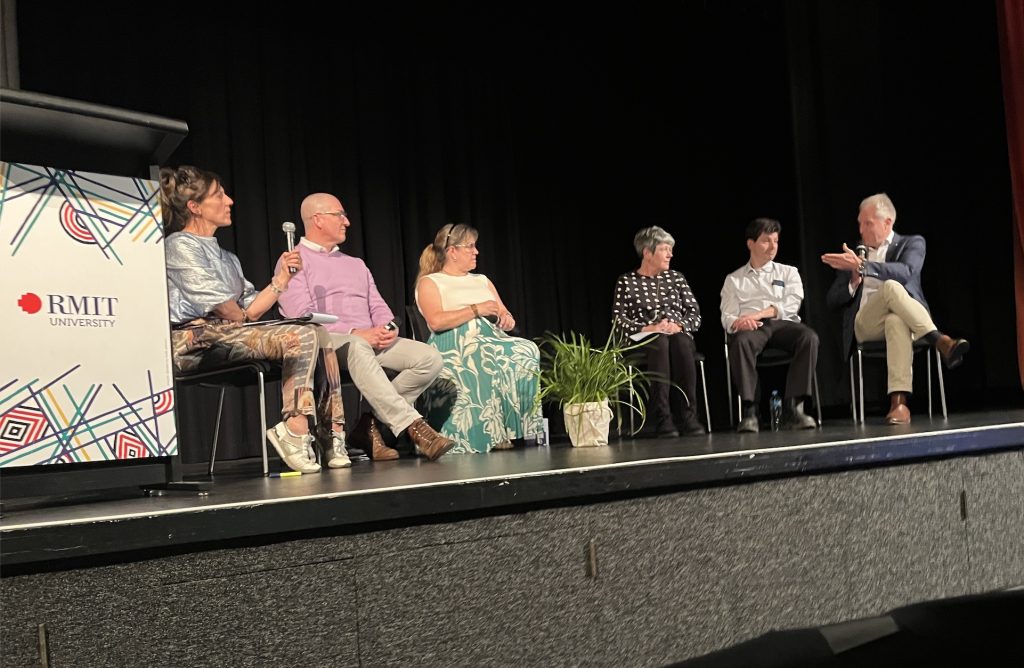
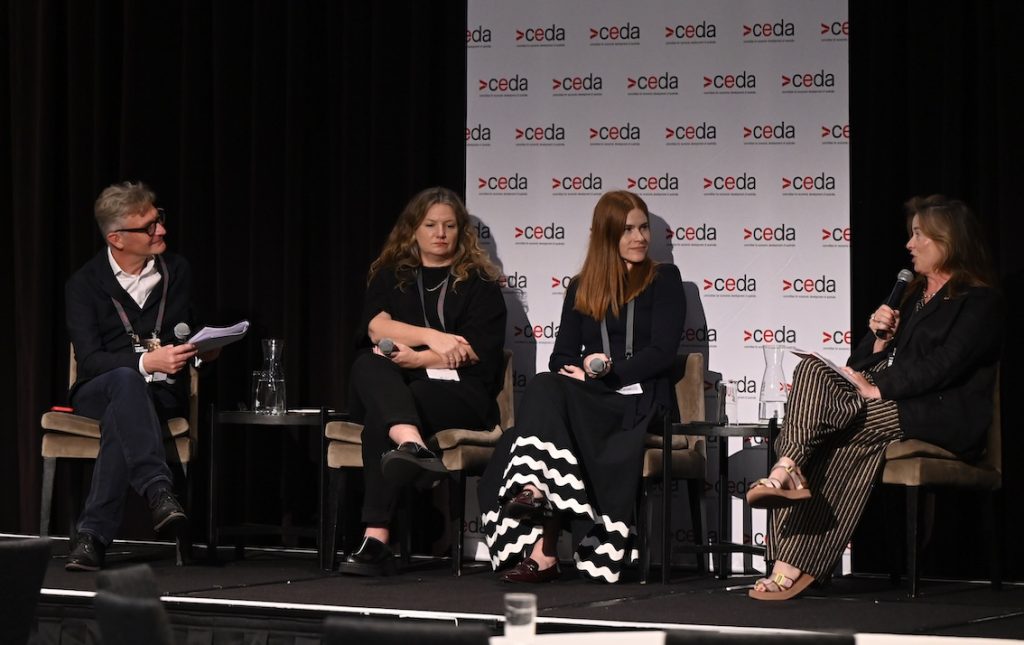
The second event featured a panel led by Connal Parsley in conversation with Hélène Frichot, Jake Goldenfein and myself on AI and decision-making systems, particularly in government administrative contexts: https://tinyurl.com/546djb77 Connal presented his research project “The Future of Good Decisions,” which examines how we might develop normative principles for decision system design in an evolving techno-social ecology. Connal challenged the dominant “disruption paradigm” that views technologies as simply disrupting well-functioning systems. Instead, he proposed an “ecological approach” that acknowledges how human and technical systems co-evolve, requiring new frameworks for evaluation.

A central concern was how legal and political frameworks struggle to properly evaluate algorithmic decision-making. Traditional administrative law principles focus on individual human decision-makers, while algorithmic systems operate on system-level targets with different logic. The gap between these approaches creates governance challenges.

The panel explored how speculative methods such as Live Action Role Play (LARP) could help reimagine decision systems. Connal and I share collaborations with Ros Catlow Furtherfield gallery and her teams of LARPers for addressing complexity in digital economies.
Jake Goldenfein highlighted a critical insight: “Law can strongly grab onto things at the application level, but only weakly grasp the circulations that make those things possible.”
What struck me deeply were the parallels between these seemingly unrelated discussions:
1. Ecological Systems Thinking
Both events emphasised how siloed approaches fail to address complex problems. The food security discussion recognized that you can’t separate food from housing, income, and agricultural systems. Similarly, the AI panel proposed viewing decision systems as ecologies rather than isolated technological implementations.
3. Participatory Design as Resistance
Both conversations highlighted the importance of participation in redesigning systems. The food security network emphasised community infrastructure and “Brazil’s model” of involving citizens. The AI panel proposed LARP as a methodology to involve diverse stakeholders in reimagining governance.
5. Values as Foundation
Perhaps most importantly, both events recognised that values must precede technical implementation. As one food security participant noted, “Social value should equal economic inclusiveness.” In the AI discussion, Parsley proposed “eco-normativities” as an approach to values that recognizes how they emerge from socio-technical systems.
I left both events with renewed appreciation for cross-disciplinary conversations.
Whether we’re building food systems or decision systems, the challenges of our time require us to think ecologically, acknowledge power dynamics, and centre community participation.
#SystemsThinking #FoodSecurity #AIGovernance #CommunityParticipation #RMIT
Related posts
The Model Is the Problem, Not the Technology
A Speedy report back on last nights opening RMIT Regenerative Futures Institute Explainer event that...
Cooperation, or the Lack of It
Two events I attended recently, on the surface, have almost nothing in common — one was an exhibitio...

Staying in the Aporia
Augustine, writing to God in Book XI of the Confessions, admits he doesn’t know what time is....
Pirate DRS 2026
Thank you to all the speakers who survived the onslaught of “walk the plank”, “pir...
Data Otherwise
Data Otherwise: More-than-Human Data Practices at DRS 2026 What if the problem with data isn’t...
DRS 2026 summary and list of RMIT papers
I’ve been fortunate to be at DRS 2026 in Edinburgh this week, about to catch a train and then...
Making Knowledge, Fragmenting Certainty
Friday 22nd, 2026 at Monash, design researchers presented artifacts from their practice—Jon McCormac...
YOU ARE NOT FEEDSTOCK
Last week at The Capitol Melbourne, we launched the RMIT Regenerative Futures Institute. I want to t...
What Doesn’t Need To Be New: Two Launches, One Week, One Paradox
Last week brought two events exploring regenerative futures from very different angles. On one after...

What does it mean for a university to be alive?
The RSA (The royal society for arts, manufactures and commerce), RMIT’s Regenerative Futures I...
Launching RFI…!
Universities are extraordinarily good at adding things. Sustainability offices. Innovation hubs. Int...
Three provocations on designing futures worth watching / reflecting…
Over recent weeks, we’ve been hosting talks from visitors who come through Melbourne. Always fun to...
What Would It Take to Read the Label?
February’s Futures Collider at RFI put three provocations in a room and asked people to act ou...
What Gets Counted When Institutions Choose Speed
Two Sessions at FACT 2026 Reflections on qualitative knowledge, AI efficiency pressures, and what ge...
Two Rooms, Two Temporalities
Two events at RMIT over the past couple of weeks revisited the temporal challenges at the heart of h...

Temporal Traps
Ending the year between collapse and care: three December gatherings on time, action, and giving bac...