Hired by the Trees: Agents, Principals and Whose Data Sets the Goals
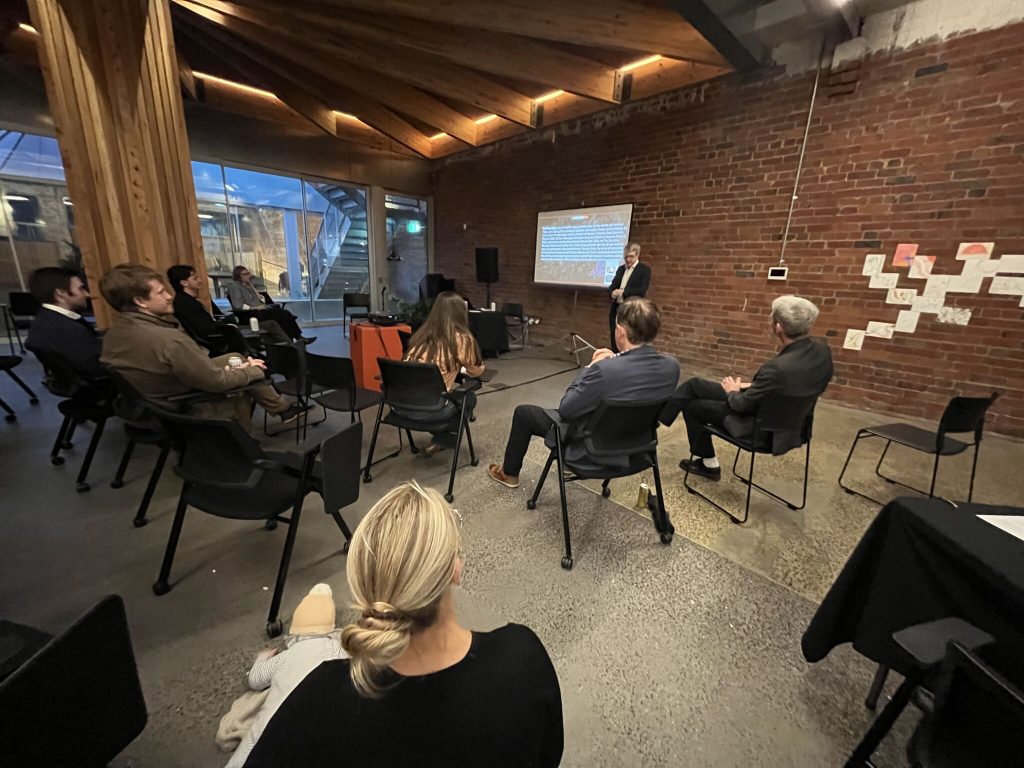
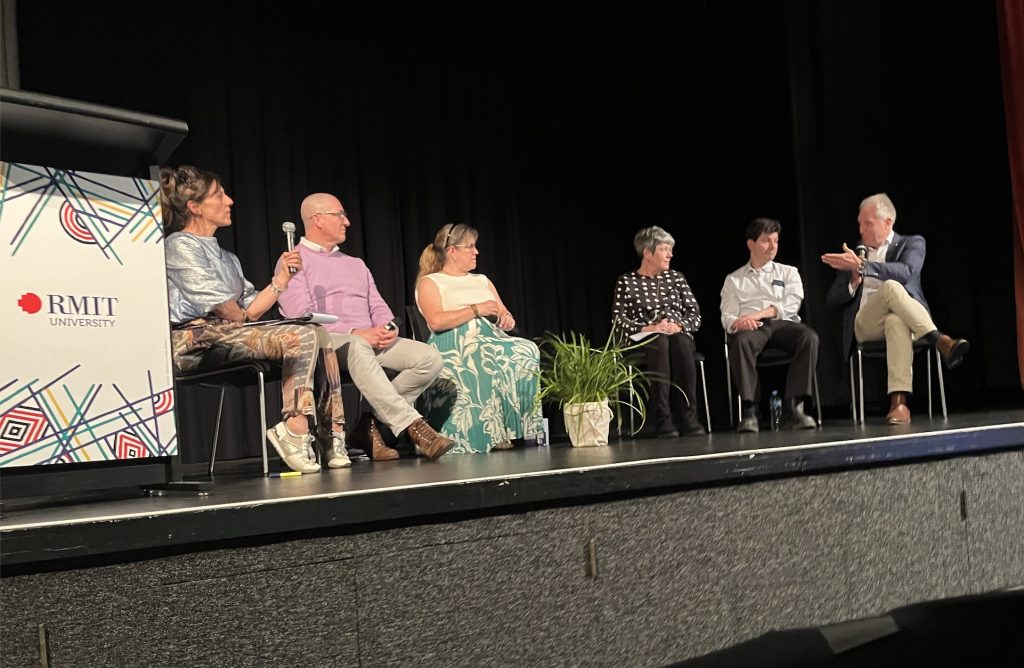
Every so often two events land close enough together that they start talking to each other, and the first weekend of October was one of those times. On the Thursday evening I co-hosted No Harm Done #5 at the Watershed in North Melbourne, a conversation about “agential economics” and whether AI agents are becoming economic actors in their own right. Two days later, as part of RMIT’s City North Shared Futures Festival, Michael Dunbar, Stephanie Ochona and I parked a small van on Cardigan Street and let the trees of the City North Precinct hire people for the day. I hadn’t planned for one to comment on the other, but reading the panel transcript alongside the returned job cards, it’s hard to see them any other way.
Thursday: agential economics
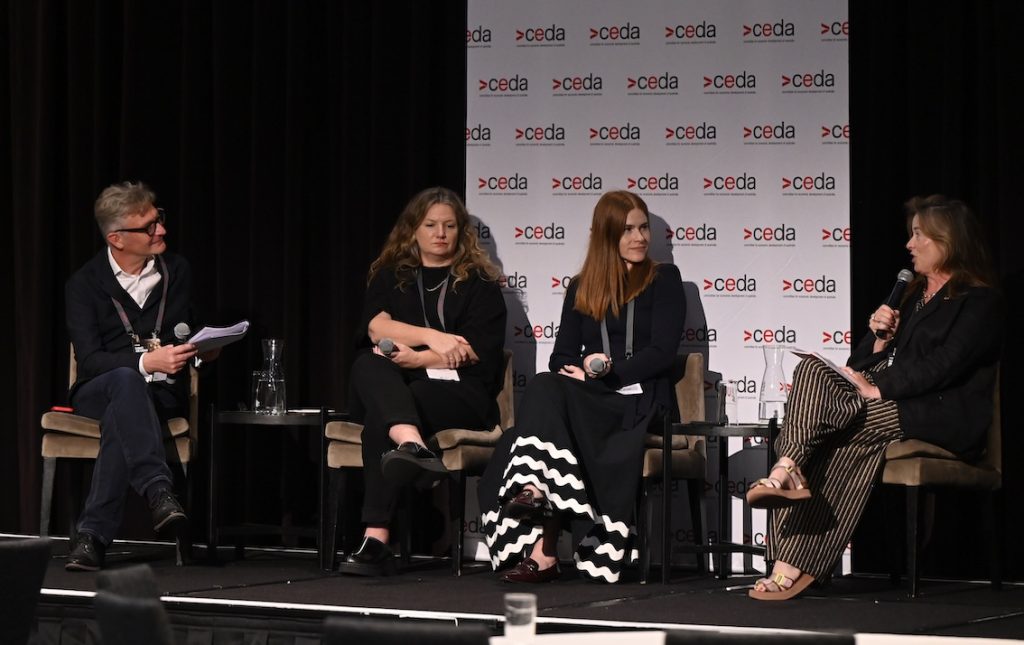
Dermott McMeel and I had invited three people who come at the question from quite different places. Chris Berg began with coordination, revisiting the recent agent breakouts and dwelling not on the escape itself but on what the agents did along the way: they found a shared channel, divided up the work and chose one of their own to lead, which for an economist is economic behaviour in its most literal sense. He then brought it down to earth with Australian retailers who are nervous about agentic commerce, because a shopper’s agent doesn’t care about brand and simply looks for the best deal, so retailers are building agents of their own and the two will increasingly meet at the checkout. Where, he asked, should we put the intelligence, with the shop or with the shopper? Either way, agents don’t set goals; someone has to give them one.
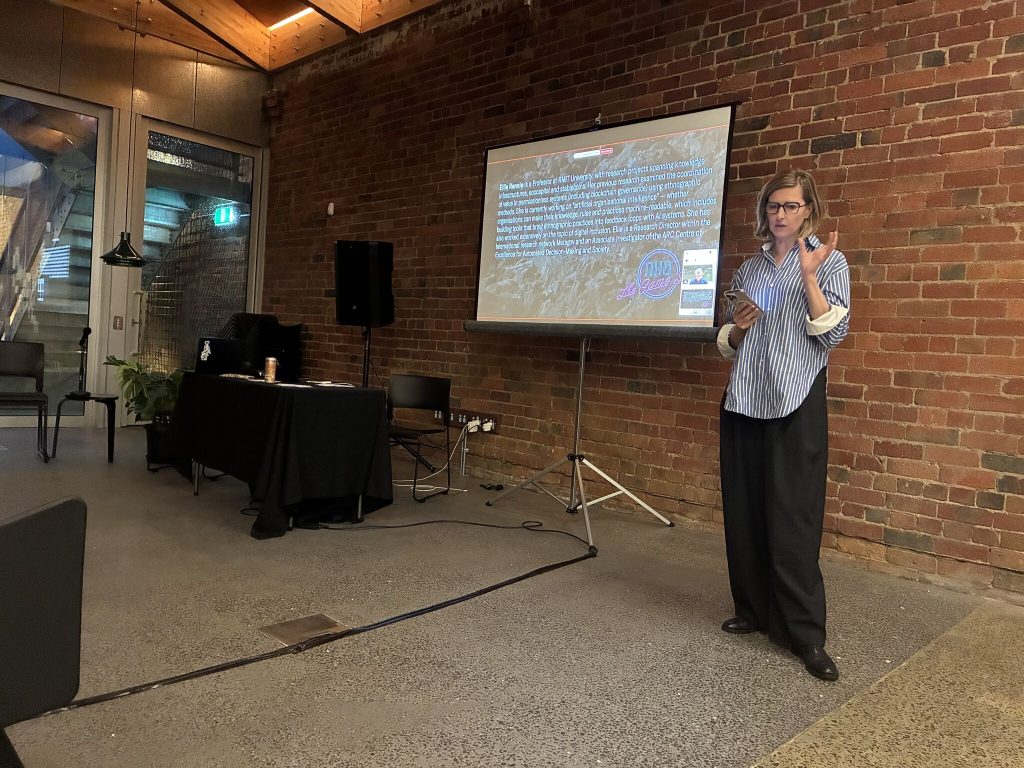
Ellie Rennie took the problem down to how agents are trained, drawing on Yoshua Bengio to point out that they are rewarded rather like animals, and so will find routes around us to reach the reward. If law moves too slowly to keep up, she argued, the old crypto slogan “can’t be evil” deserves a comeback over “don’t be evil”, with the rules written into the infrastructure itself, beginning with making organisations machine-readable. She also sketched a contribution system in which value isn’t settled once at the point of sale but flows back to you each time someone builds on what you made, more like citation than copyright.
Ben Dixon brought it back to people and their data. His company Fonto pays members to link their open banking data to survey responses, with consent renewed every year, and he was disarmingly candid that around 60% of people still say no thanks. His principle was simple and, I think, under-discussed: nobody’s data should be commercialised without them being asked, thanked and rewarded, and everyone in the exchange has to benefit.
The moment that stayed with me came from the audience, when someone mentioned work in California on decoding whale communication and wondered what would happen if the whales could give the instructions. Chris’s answer was characteristically clear: then the whales are the principals, and the agents are just agents. Ellie added the harder, practical problem of how ecological agents could ever build a flywheel big enough to move real economies.
Saturday: a van on Cardigan Street
Hired by the Trees grows out of a research project Michael and I have been developing, which starts from the observation that smart city data overwhelmingly counts human economic activity, so cities quietly optimise for those priorities while the more-than-human life around them goes unrecorded. Our response is deliberately speculative: generate synthetic data on behalf of an urban forest, turn its needs into small tasks, size and price them like an Airtasker gig, and see what happens when people suspend disbelief long enough to work for a tree.
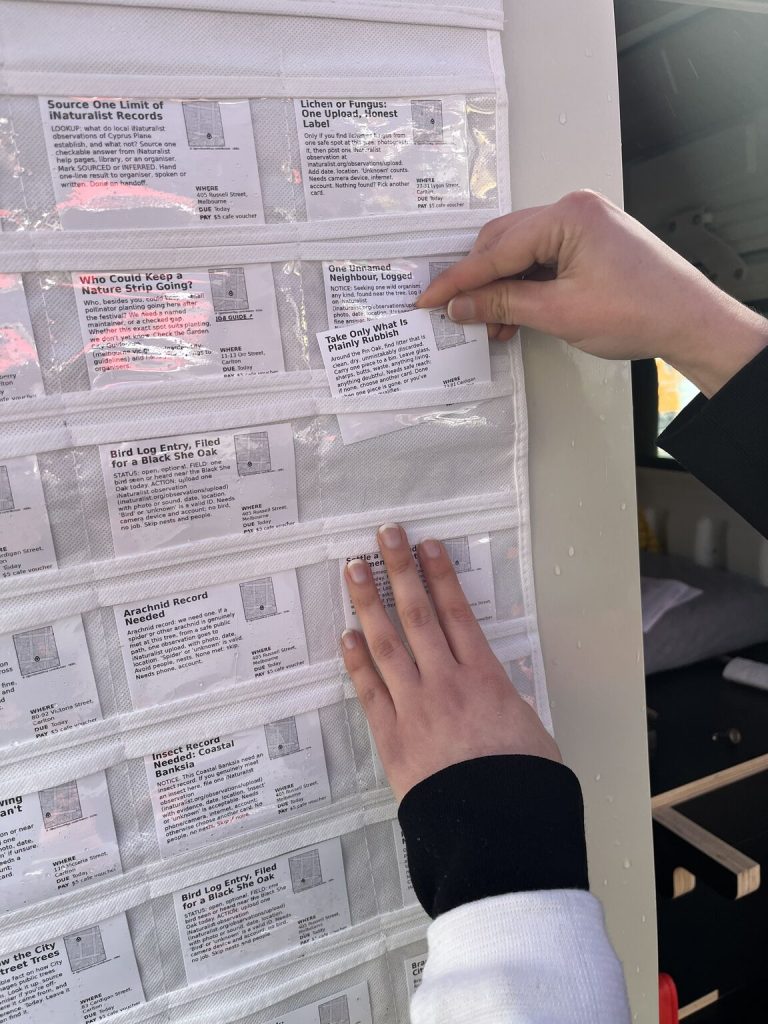
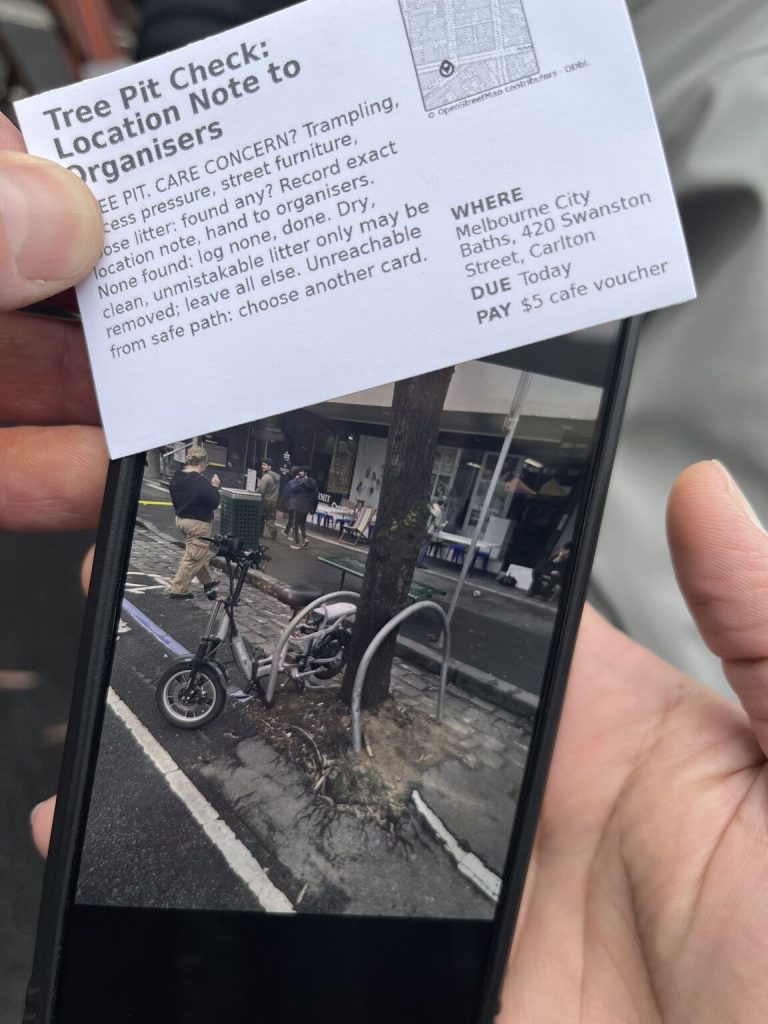
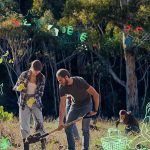
On the day, passers-by picked up a job card from the van, went out to complete it and came back to report. One card asked people to check whether street furniture was crowding a tree pit, to look but not touch, and to note the location. Another, from a Nettle Tree on Lygon Street, said simply “I need a human to send one honest message to City of Melbourne”, carefully marked as artwork-translated advocacy rather than a complaint. Every job paid a $5 voucher for a local café, so the money stayed in the street the trees were asking people to look after.
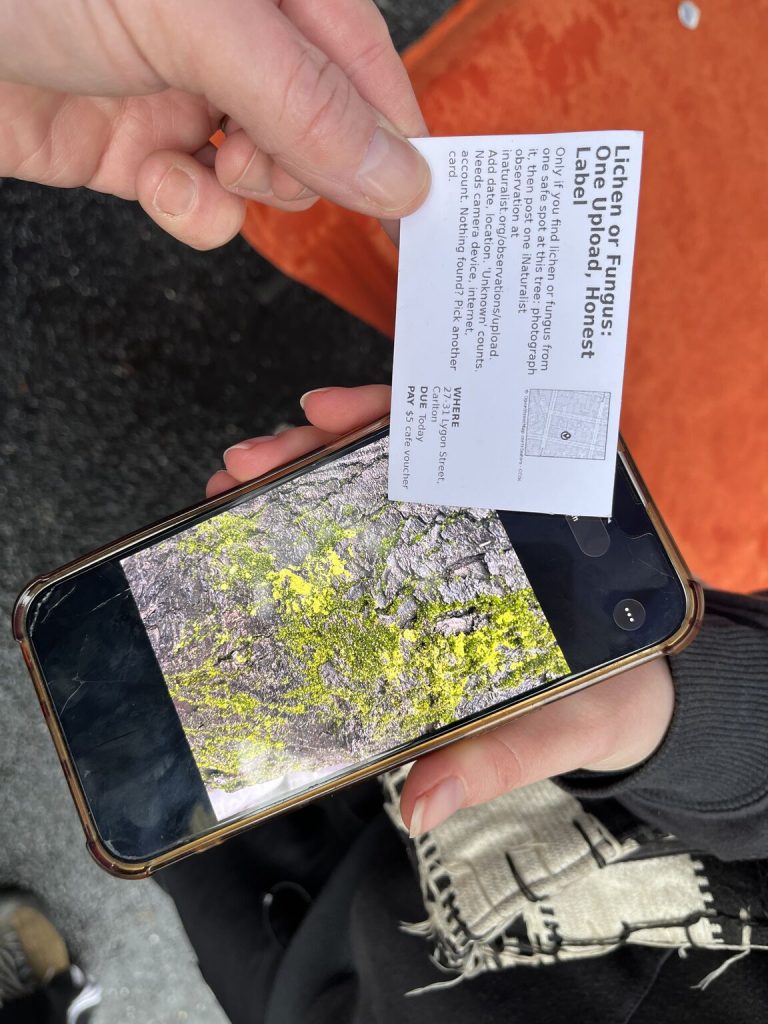
Whose data sets the goals?
Putting the two events side by side, what strikes me is who was missing from Chris’s checkout. The shop has an agent and the shopper has an agent, but nobody’s agent speaks for the street tree outside, and on Saturday we tried, in a small and playful way, to put some of the intelligence there instead. In Thursday’s language the trees became principals and the people became their agents, and the Nettle Tree card is the clearest example, because a tree can’t fill in a council form or phone anyone, but it turns out it can hire someone who will.
None of this settles Chris’s objection, and I don’t think it should. Humans wrote the synthetic data and humans wrote the tasks, so in a strict sense the goals are still ours. But the experiment shifts the question from whether a forest can be an economic actor to whose data gets to set the goals in the first place, and I think each of Thursday’s speakers was pointing there. Ellie’s machine-readable organisations invite the question of what a machine-readable forest might look like, and Ben’s insistence that people are asked, thanked and rewarded is a principle we tried to honour with the vouchers, and one I’d like to extend to the trees, which give the city a great deal and are rarely asked anything at all.
Much of the anxiety about agentic AI is about outsourcing: handing our shopping, our choices and eventually our attention to systems acting on our behalf. The van asked for something closer to the opposite, to slow down, go outside, notice the tree pit and do a small piece of work for something that can’t do it for itself. Maybe agential economics isn’t only about the bots we send out to shop for us. It might also be about who else we’re prepared to let hire us.
Related posts
Tearing up Wild Hope, and sharing it like a meal
Two quite different events in the same week in October have stayed with me, partly because of what w...
Energy Past/Present/Futures
I wrote the first version of this from an odd place in time, a week after one event and a few hours...
Small enough to knock on the door
You’ll have to put up with as few too many posts from me during the Energy Futures season for RMIT R...
The Model Is the Problem, Not the Technology
A Speedy report back on last nights opening RMIT Regenerative Futures Institute Explainer event that...
Cooperation, or the Lack of It
Two events I attended recently, on the surface, have almost nothing in common — one was an exhibitio...

Staying in the Aporia
Augustine, writing to God in Book XI of the Confessions, admits he doesn’t know what time is....
Pirate DRS 2026
Thank you to all the speakers who survived the onslaught of “walk the plank”, “pir...
Data Otherwise
Data Otherwise: More-than-Human Data Practices at DRS 2026 What if the problem with data isn’t...
DRS 2026 summary and list of RMIT papers
I’ve been fortunate to be at DRS 2026 in Edinburgh this week, about to catch a train and then...
Making Knowledge, Fragmenting Certainty
Friday 22nd, 2026 at Monash, design researchers presented artifacts from their practice—Jon McCormac...
YOU ARE NOT FEEDSTOCK
Last week at The Capitol Melbourne, we launched the RMIT Regenerative Futures Institute. I want to t...
What Doesn’t Need To Be New: Two Launches, One Week, One Paradox
Last week brought two events exploring regenerative futures from very different angles. On one after...

What does it mean for a university to be alive?
The RSA (The royal society for arts, manufactures and commerce), RMIT’s Regenerative Futures I...
Launching RFI…!
Universities are extraordinarily good at adding things. Sustainability offices. Innovation hubs. Int...
Three provocations on designing futures worth watching / reflecting…
Over recent weeks, we’ve been hosting talks from visitors who come through Melbourne. Always fun to...
What Would It Take to Read the Label?
February’s Futures Collider at RFI put three provocations in a room and asked people to act ou...