Data Otherwise
Data Otherwise: More-than-Human Data Practices at DRS 2026
What if the problem with data isn’t its volume, its accuracy, or its resolution, but what it forecloses?
This was the question that structured two of the more intellectually ambitious activities at DRS 2026 in Edinburgh: a full theme track on more-than-human data practices, and a companion embodied Exploration that took participants out into the city to walk through data worlds. I want to try to account for both here — what the track argued, what the Exploration did, and where I think this work is headed.
The track: from data from the world to data with the world
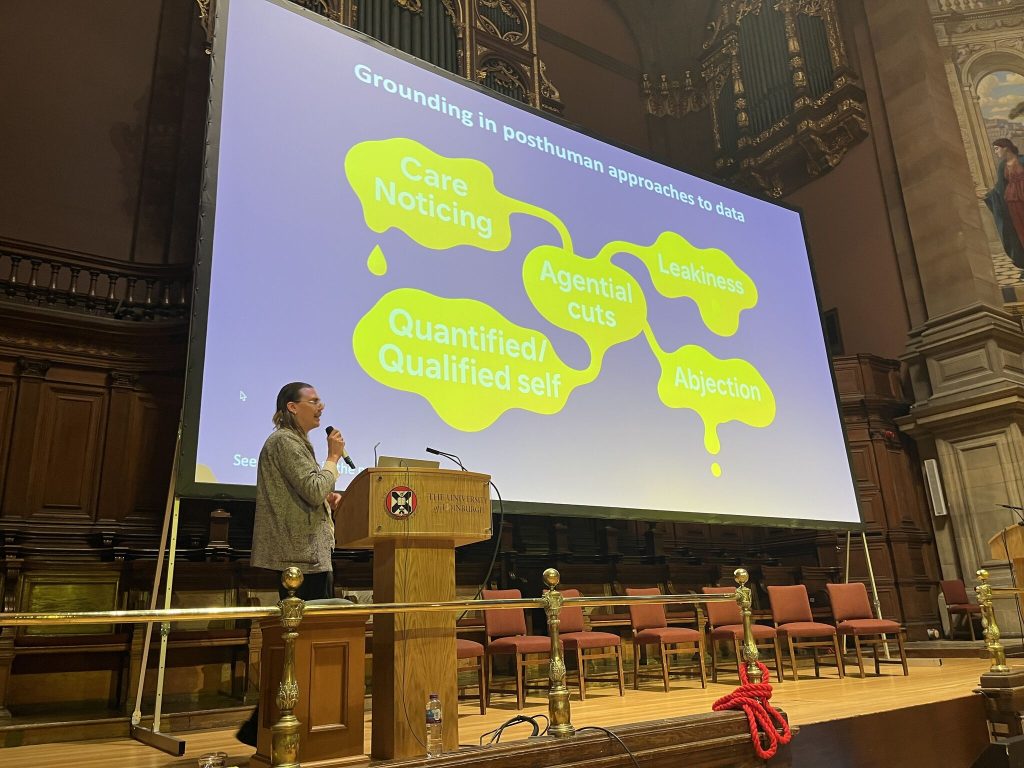
The More-than-Human Data Practices track — developed with Elisa Giaccardi, Sara Lenzi, Vasiliki Tsaknaki, and Jiwei Zhou — brought ten papers across two sessions in McEwan Hall around a single provocation: that dominant data infrastructures don’t simply describe the world. They organise it. And the categories they use to do so are doing political and ontological work that most data practice treats as settled.
The track paper frames this across three registers. Cosmopolitically, data infrastructures determine who and what count as legitimate participants in knowledge production — which lifeforms are legible, which temporalities are admissible as evidence, which ways of knowing qualify as data at all. Epistemologically, they challenge the assumption that knowledge flows through human perception and human categories, rendering invisible the agentive capacities of the non-human actors with whom designers are already entangled. Ontologically — and here the argument is hardest but most consequential — dominant data paradigms operate as what Dan McQuillan calls “machinic neoplatonism”: applied metaphysics that presents itself as neutral and external, accruing authority precisely by concealing its own constructedness, and machining that authority into the world.
This last point matters more than it might first appear. It isn’t just that data practices have limitations, or that they involve choices. It’s that the computational infrastructure through which data comes to matter actively converts predictions into pre-emptions, closing off futures before they can be contested. What we called in the track paper “ontological foreclosure” isn’t a bug in the system. It’s a feature of the representational logic that underpins most contemporary data practice.
The papers held this argument under pressure from multiple directions.
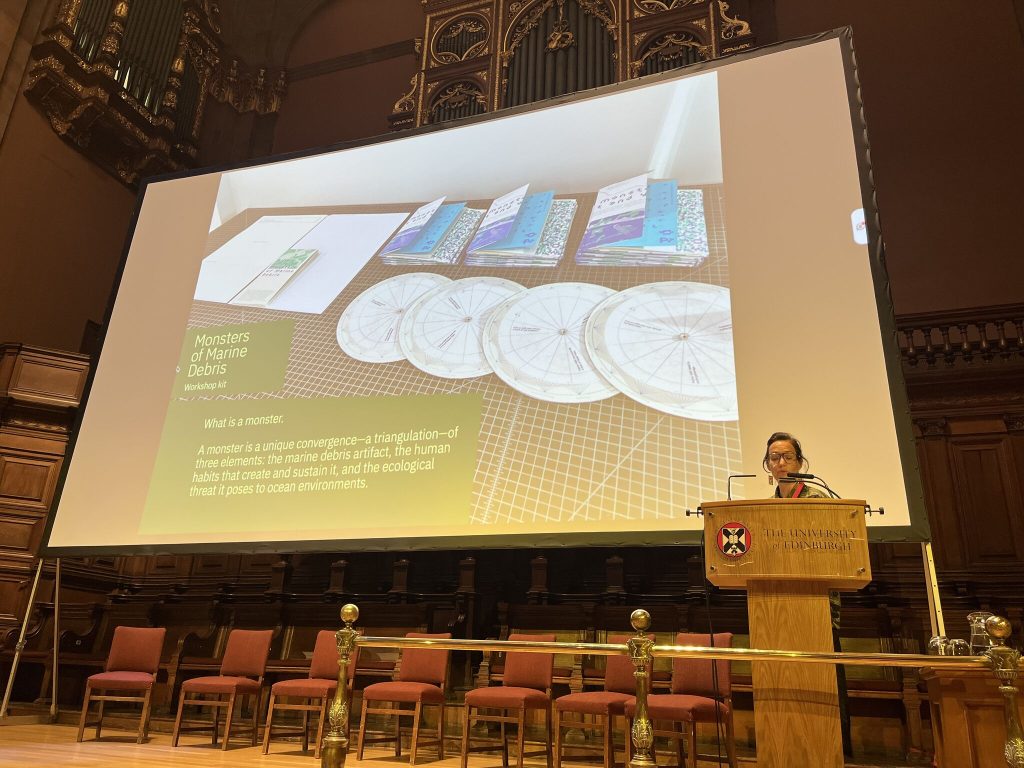
Michelle Westerlaken and Sonja Rattay’s work on AI sustainability tools in large corporations surfaces four deep tensions between what computational systems require and what living ecosystems actually are: between demands for certainty and the irreducible instability of ecological dynamics; between data as neutral evidence and data as argument in corporate trade-off management; between LLMs as synthesis tools and the continued necessity of human interpretation; and between functional tool aesthetics and the vital, affective attachments that regenerative change actually requires. Their proposed design space — oriented toward technosymbiotic relations and ecological meaning-making — is one of the more concrete attempts in the track to move from critique into practice.
Martín Tironi and Manuela Garretón did something different: they grounded AI literally. Their research-creation project in Penco, Chile — where a rare earth mining project has generated a complex socio-environmental controversy — uses terrestrial cartography to expose the geological, energetic, and social processes hidden beneath what gets framed as immaterial cloud infrastructure. AI is not ethereal. It has a territory. Their methods — what they call diplomacy (cultivating encounters between heterogeneous temporalities and more-than-human agencies) and relationality (interweaving geological, industrial, ecological, and social scales into shared spatial narrative) — offer one answer to the question of what it means to design with planetary awareness.
Anton Poikolainen Rosén’s autoethnographic account of urine protein monitoring mapped nitrogen metabolism from personal health data to Baltic Sea overfertilisation, demonstrating that self-tracking is never only self-tracking: it is always already ecological entanglement. The paper calls these practices “rituals of careful noticing” — a phrase that does a lot of work, suggesting that attunement rather than extraction might be the operative mode for more-than-human data practice.
Sebastian Gonzalez Quintero and Dietmar Offenhuber deployed sensors in the Charles River in Boston and found the instruments colonised by organisms — organisms dwelling on the device housing, co-opting the sensor, becoming part of the sensing apparatus. This is not a methodological failure. It is a finding: that the boundary between instrument and world is not clean, that the sensor participates in the ecology it is measuring, and that this participation is data too.
Running beneath all of it was a shift the track tried to name precisely: from data from the world to data with the world. Not as metaphor — as a design commitment that changes what instruments are for, what rigour means, and who or what counts as a knowledge co-producer.
Our own contribution: instruments and synthetic worlds
Michael Dunbar, Rusaila Bazlamit, and I contributed two papers to the track, both circling the instrument question from different angles.
Everything is an Instrument — developed with Rusaila and Michael — follows a pedagogical experiment in which students built bespoke data instruments to sense Federation Square in Melbourne. The experiment wasn’t primarily about producing better data. It was about what happens to designers when they are responsible for the instrument rather than simply deploying one. As students’ instruments broke, resisted, failed to measure what they expected, or were occupied by more-than-human actors, something shifted in their understanding of their own role. We call this “instrumental consciousness” — the moment a designer grasps, viscerally, that the instrument is not a window onto the world but a participant in it, co-constituting what becomes knowable. Drawing on Barad’s agential realism and Lupi’s Data Humanism, the paper argues that making-as-research is a critical method for interrogating how instruments shape experience, participation, and exclusion in data-driven environments.
https://doi.org/10.21606/drs.2026.891
KinBank — developed with Michael — takes a different approach to the same problem. Smart city data infrastructures largely reinforce anthropocentric paradigms, rendering invisible the entangled relationships that constitute more-than-human urban worlds. KinBank is a speculative interface that uses synthetic data to generate transactional representations between human and non-human urban actors: pollination services provided by bees, decomposition processes contributing to soil nutrients, oxygen production by maple trees, data collection impacts on wildlife populations. By adopting the metaphor of a shared bank account, the system foregrounds ecological and financial interdependencies while challenging the reductionist logic of conventional data practice. The point of synthetic data here isn’t prediction or optimisation — it’s what we call “productive uncertainty”: generating representations that surface unseen relationships, embrace ecological complexity, and provoke critical reflection on what the existing data infrastructure has decided not to count.
https://doi.org/10.21606/drs.2026.2825
Both papers circle what might be the central design challenge in this space: how do you design instruments that are accountable to the conditions of their emergence — that make their own partiality visible rather than concealing it as objectivity?
The Exploration: walking into data worlds
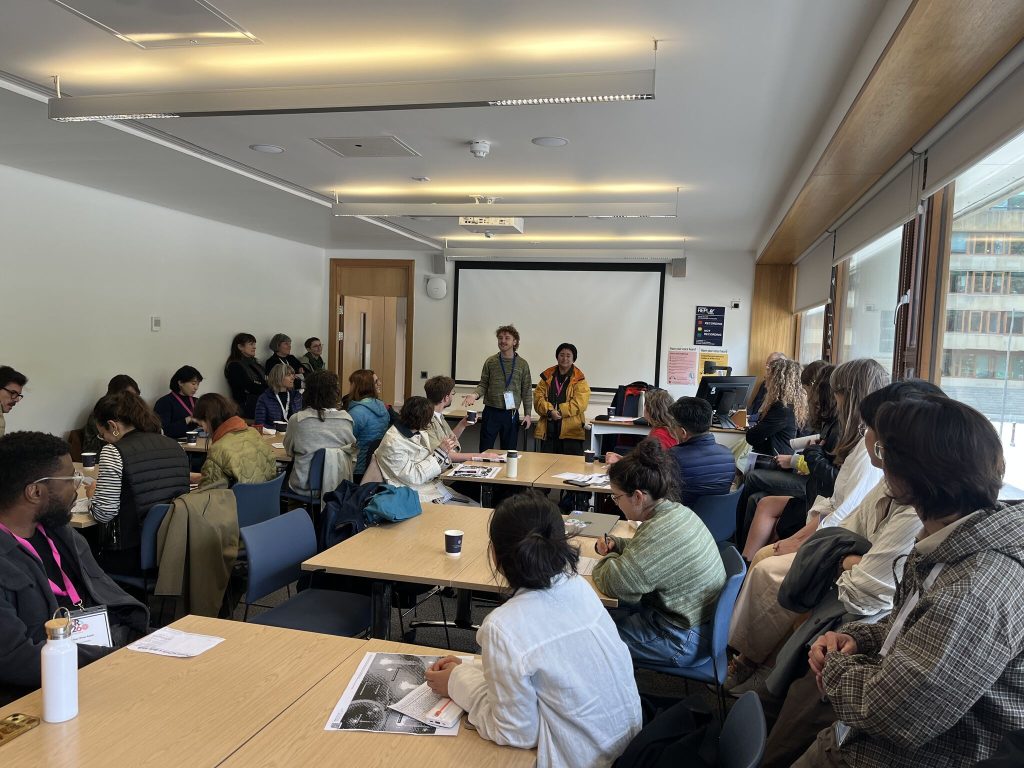
The companion Exploration — “Exploring Data Otherwise: Countermapping More-than-Human Design Practices” — took the track’s arguments somewhere more embodied. Organised by the same group, with significant design and facilitation work by Marco Finardi and Steph Ochona, the workshop asked participants not to analyse data worlds but to inhabit them.
Three data worlds were designed for the occasion, each operating at a different scale and drawing on a different dataset and sensing methodology.
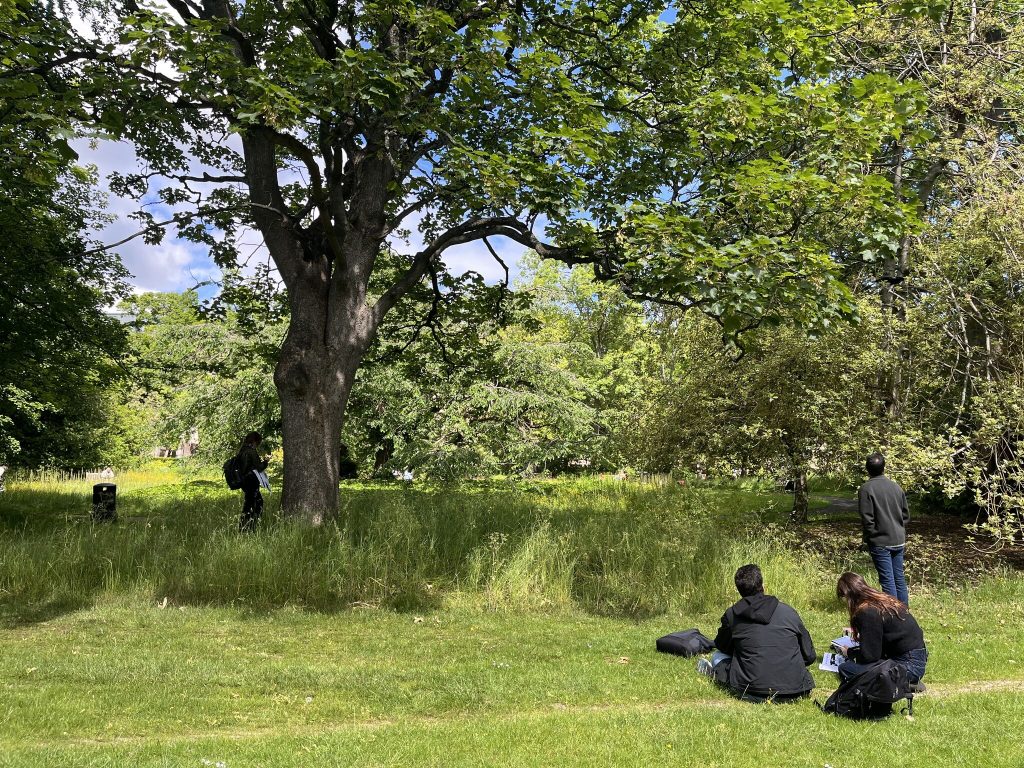
At the micro-scale: Stanislav Roudavski’s LiDAR 3D scans of tree trunks — surface geometry, hollows, bark texture, the traces of burning and regrowth, Indigenous cultural meanings made legible through geometric analysis and colour-scale visualisation. The data world of a tree is a world of point clouds and surface feature categorisation, of decisions about what counts as a topological feature and what falls below the threshold of detection. The diagram produced for participants showed this explicitly: a thinning line marking information filtered out in processing (readings outside sensing ranges, noise, data not fitting chosen categories) and a thickening line marking information introduced (inferences, categories, assumptions added to interpret and visualise). The instrument does not simply record. It makes and unmakes.
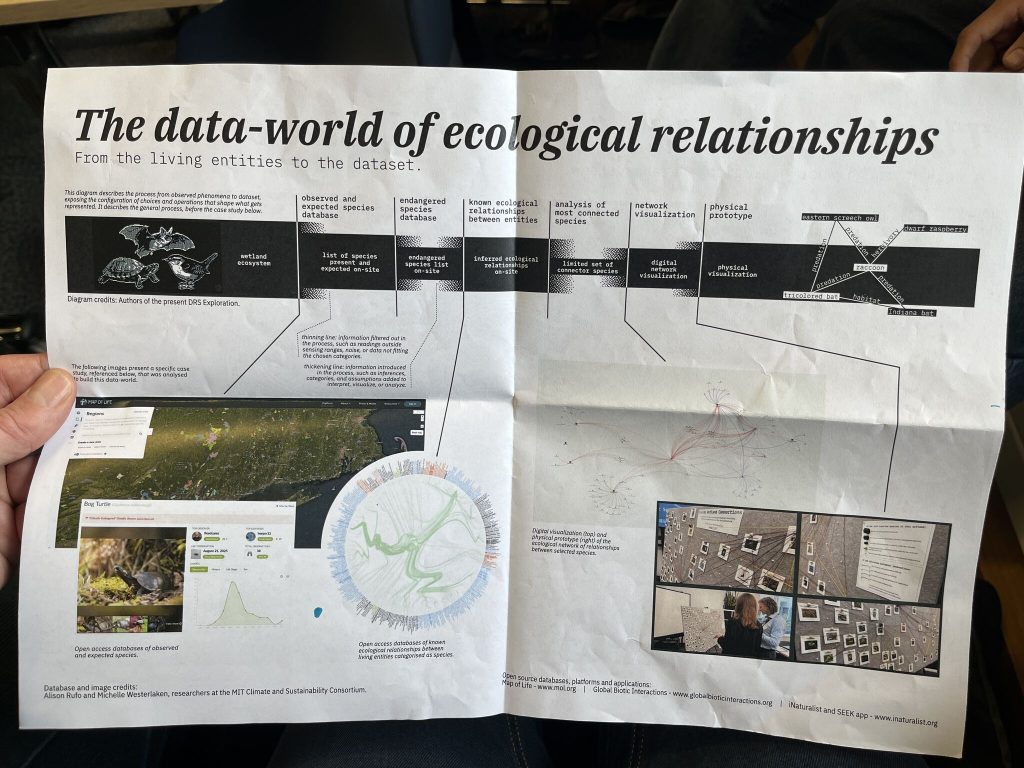
At the meso-scale: Michelle Westerlaken’s biodiversity network data — endangered species expected at a wetland site in New York State, their ecological interactions drawn from Map of Life, Global Biotic Interactions, and iNaturalist, and visualised as a physical network graph. From the six most endangered species at the site, four connector species emerged through network analysis: the raccoon, and three bat species, each connected to two or more of the protagonists through predation, herbivory, or habitat relations. The data world of ecological relationships is a world of CSV exports, IUCN threat statuses, inferred interactions, and the gap between what is recorded and what is actually happening in a wetland on a given day.
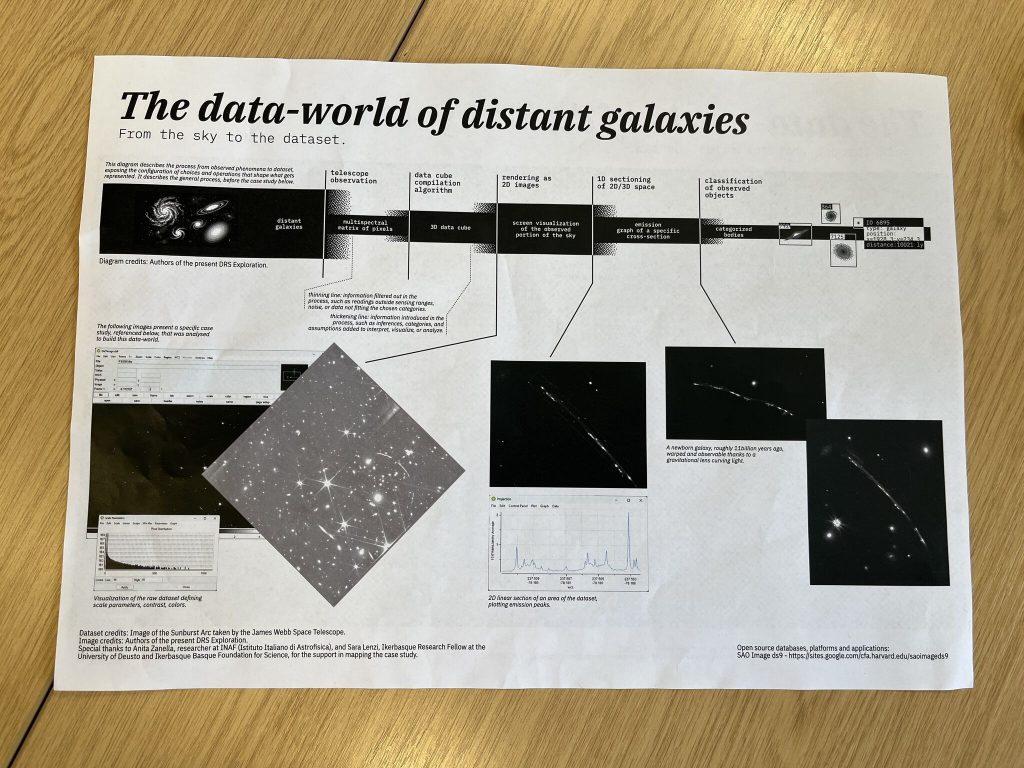
At the macro-scale: Sara Lenzi’s astronomical data — distant galaxies observed through telescopes, translated from multispectral matrices of pixels into 2D images, classified into catalogued bodies. The galaxies are distant not only in space but in time: to observe them is to look into the past, to encounter light that left its source millions of years ago. Astronomers rely on manual visual inspection — zooming, colour coding, digital filters — searching for serendipitous discoveries. Sometimes seeing is not enough; they use sonification to listen to data, identifying patterns behind the noise of cluttered images. The data world of distant galaxies is a world of data cubes, gravitational lenses bending the space-time continuum, and the perpetual negotiation between what the telescope can resolve and what remains below detection.
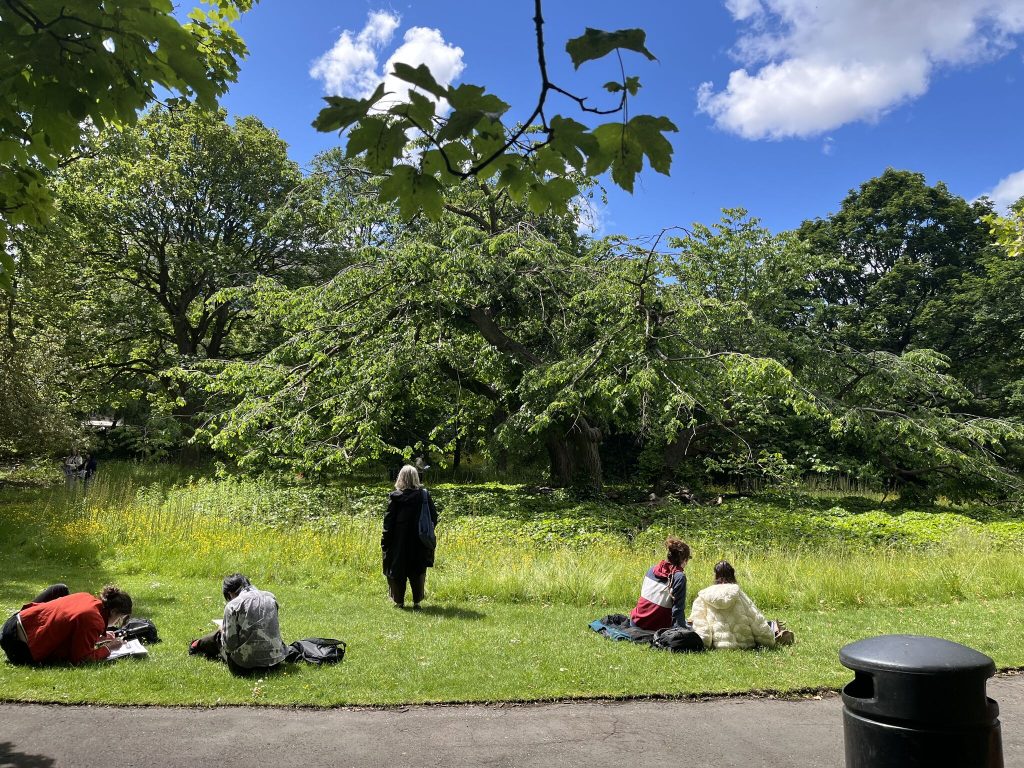
Participants received A3 printed maps and diagrams for each world, audio guides co-written with AI that narrated each data world as a place to be inhabited rather than a dataset to be analysed, and then went out into Edinburgh to find their data world there. They were asked to embody a more-than-human perspective — to find a tree and try to see it as a point cloud, to find a horizon and look for light as an astronomer would, to find a place they thought had lots of ecological connections and follow those threads. They took field notes. And then they made postcards from nowhere: sketches of what each data world rendered invisible, what was thinned out or foreclosed in the move from phenomenon to data point.
The provenance question kept surfacing throughout — who collected this data, with whom, through what instruments, and to what end — not as a methodological footnote but as the ethical core of the whole exercise. A diagram of how a dataset is produced, with whom, through what devices, is itself a political document. The thinning line and the thickening line are design decisions, not neutral technical operations.
An underlying question that the workshop surfaced but did not resolve: is more-than-human data for humans? Do more-than-human entities care about data? And if we need data because we live in a human-dominated world that requires translation across agencies — what responsibilities does that create for how we design the instruments of translation? Is there another layer — not data at all — where knowledge might be shared between agencies more directly?
I don’t think those questions resolved. That felt right.
What the field is working on
Taken together, the track and the Exploration map a research space that is still finding its form — which is both its limitation and its energy. The track paper is explicit about this: the papers collected do not resolve the challenge of moving from critique into design practice. They advance it. They map the contours of a practice that is only beginning to articulate what it would mean to be rigorous in a different register — one that expands what rigour means to include accountability alongside accuracy, attunement alongside abstraction, and participation alongside representation.
Several tensions seem to me unresolved and productive:
The scale problem. The track ranges from urine nitrogen to distant galaxies, from bark hollows to corporate sustainability AI. The methods and instruments appropriate to each scale are radically different. What would it mean for these to constitute a coherent field of practice rather than adjacent interventions?
The infrastructure problem. Critique of dominant data paradigms is now well developed. The difficulty is designing otherwise within infrastructures that weren’t built for it — that actively resist alternative logics, that reward quantification and standardisation, that make relational and situated data practices expensive and illegible to the systems that commission and evaluate research.
The instrument problem. If every designed object is a data instrument — which is the argument of Everything is an Instrument — then every design decision about what to measure, how to measure it, and what to exclude is an epistemic and political decision. This repositions the designer not as a neutral maker of tools but as someone who is co-constituting what can be known. That is a significant responsibility, and design education has not yet fully reckoned with it.
What I keep returning to is the closing provocation from the track paper: if data has long spoken for the world, how might it begin to listen?
That’s not a rhetorical question. It’s a design brief.
Related posts
Cooperation, or the Lack of It
Two events I attended recently, on the surface, have almost nothing in common — one was an exhibitio...

Staying in the Aporia
Augustine, writing to God in Book XI of the Confessions, admits he doesn’t know what time is....
Pirate DRS 2026
Thank you to all the speakers who survived the onslaught of “walk the plank”, “pir...
DRS 2026 summary and list of RMIT papers
I’ve been fortunate to be at DRS 2026 in Edinburgh this week, about to catch a train and then...
Making Knowledge, Fragmenting Certainty
Friday 22nd, 2026 at Monash, design researchers presented artifacts from their practice—Jon McCormac...
YOU ARE NOT FEEDSTOCK
Last week at The Capitol Melbourne, we launched the RMIT Regenerative Futures Institute. I want to t...
What Doesn’t Need To Be New: Two Launches, One Week, One Paradox
Last week brought two events exploring regenerative futures from very different angles. On one after...

What does it mean for a university to be alive?
The RSA (The royal society for arts, manufactures and commerce), RMIT’s Regenerative Futures I...
Launching RFI…!
Universities are extraordinarily good at adding things. Sustainability offices. Innovation hubs. Int...
Three provocations on designing futures worth watching / reflecting…
Over recent weeks, we’ve been hosting talks from visitors who come through Melbourne. Always fun to...
What Would It Take to Read the Label?
February’s Futures Collider at RFI put three provocations in a room and asked people to act ou...
What Gets Counted When Institutions Choose Speed
Two Sessions at FACT 2026 Reflections on qualitative knowledge, AI efficiency pressures, and what ge...
Two Rooms, Two Temporalities
Two events at RMIT over the past couple of weeks revisited the temporal challenges at the heart of h...

Temporal Traps
Ending the year between collapse and care: three December gatherings on time, action, and giving bac...

Notes toward the 6th finger
I’ve spent 20 years watching designers optimise products that score well environmentally while...

Rep / Non-Rep & Foreclosure
Catching up with things, and the first of two posts this week, reflecting on events last week. Stayi...