DRS 2026 summary and list of RMIT papers
I’ve been fortunate to be at DRS 2026 in Edinburgh this week, about to catch a train and then plane home back to Melbourne. “Get back to work Speed”.
I have to say I didn’t really know what I was getting into in moving to Naarm, RMIT, School of Design. Who does when it’s 10,500 miles away from your pals, network and research team?
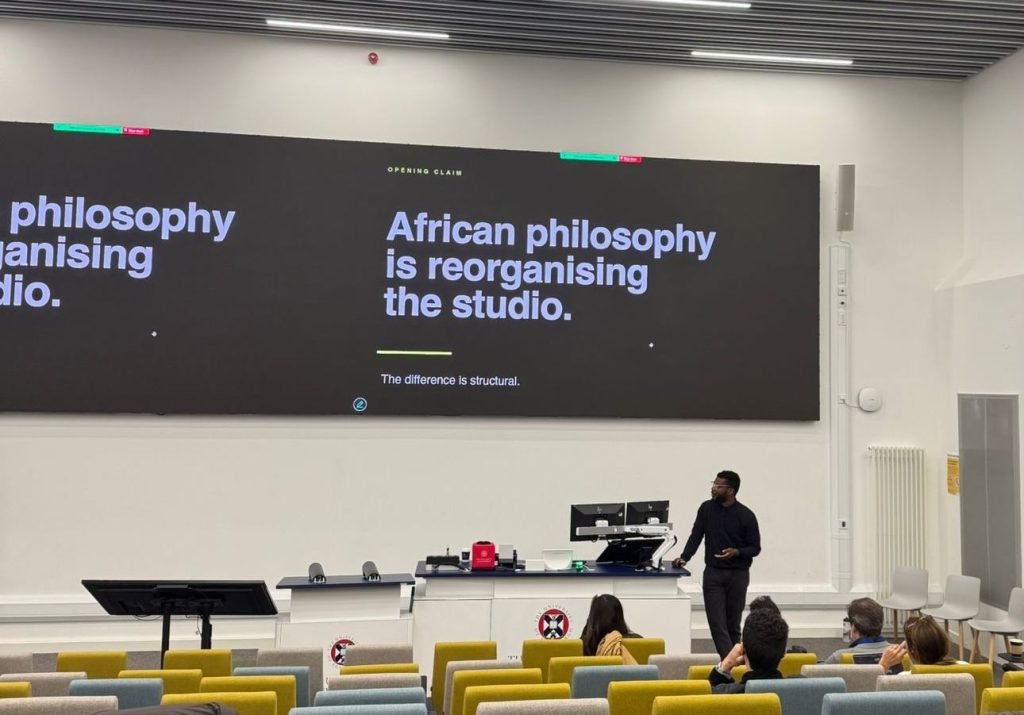
But just wow. We turned up, with 18 contributions from papers to workshops and made very ‘good trouble’. Pedagogies rooted in Ubuntu and Sankofa. Data instruments that were redefined by being ‘in the world’. Urban LARPs rehearsing regenerative futures. A neurodivergent accessibility audit, recovery of the Vietnamese word ‘đồng’ offered as a better frame for co-design than anything the Western canon has produced.
I didn’t expect to feel this way about a conference week. But watching people you work alongside stand up in front of the discipline and say something genuinely new, something provocative, does something to you.
Props to Nicola St John and Georgina Nolan for bursting the Edinburgh enlightenment bubble by acknowledging the stolen lands that remain as sources of critical minerals for Europe to sustain the dream of science.
Good work, everyone. Really good work.
Not sure if this link works, but maybe the list of things we did… (listed below anyway)
https://www.conftool.pro/drs2026/index.php?page=browseSessions&presentations=show&form_date=all&search=rmit
Antonella Autuori Korey Wetherell Yaw Ofosu-Asare, PhD
Michael Dunbar Rusaila Bazlamit Troy Innocent Carolyn Briggs Ashleigh Dharma Carlo Tolentino Jung-Joo Lee Georgina Nolan Nicola St John Javier de Urquijo Isoard Josh Riesel Jorge E. Arreola Rosendo
Liam Fennessy Laurene Vaughan Sarah Teasley Prof Simon Lockrey Stephanie Ochona Mitchell Vassie
Lan Lam Donna Cleveland RMIT College of Design and Social Context hashtag#DRS
Presentations including ‘rmit’
Understanding Sleep Challenges in Shared Dormitories: A Co-design Inquiry
Zheng Wang, Adrian Gradinar, Lisa Thomas
Lancaster university, United Kingdom
Shared dormitories are the most common living arrangement for Chinese university students and have a crucial impact on their sleep and well-being. Most studies on sleep among this group primarily focus on the physical environment and the individual person, giving far less attention to the interpersonal and social aspects of living in shared dormitories. To address this gap, this paper presents the findings of a co-design workshop with 23 participants which explored their experiences of shared sleeping spaces and involved them in prototyping interventions for improving sleep experience. Findings reveal interpersonal interference as a major factor behind sleep disruption. Even though students experience negative emotions, they tend to adopt passive coping behaviours, reflecting conflict avoidance linked to broader cultural tendencies in Chinese society. This study also highlights the crucial role of interpersonal dynamics in shared dormitories, concluding that future design interventions should prioritise improving communication and consensus among roommates.
View Paper: https://doi.org/10.21606/drs.2026.629
Session Details:
PAPERS: Designing Environments for Wellbeing
Time: 08/June/2026: 11:00am-12:30pm · Location: 40 George Square, LG.09
Accessibility: https://www.accessable.co.uk/the-university-of-edinburgh/central-area/access-guides/george-square-40-lecture-theatres
Unmaking AI’s classificatory ontologies: Situated annotation as design inquiry in human–AI assemblages
Antonella Autuori1,2
1Institute of Design (IDe), University of Applied Sciences and Arts of Southern Switzerland (SUPSI), Mendrisio, Switzerland; 2School of Design, RMIT Melbourne, Australia
This paper examines how design research can unmake AI’s classificatory ontologies through situated and embodied annotation practices. Drawing on feminist, queer, and critical data epistemologies, it reframes bias not as a technical flaw but as a generative condition that reveals how knowledge is produced and negotiated within human–AI assemblages. An autotheoretical experiment grounds the inquiry. The researcher creates and annotates a dataset of self-representations using subjective, affective, and relational labels, training a small-scale model to probe classification as an interpretive encounter shaped by embodiment, ambiguity, and positionality. Building on the shift from debiasing toward reflexive data practices in design and HCI, the paper proposes situated annotation as a design inquiry for unsettling inherited AI ontologies and repositioning machine vision as an accountable, partial, and embodied way of knowing.
View Paper: https://doi.org/10.21606/drs.2026.1239
Session Details:
PAPERS: Queer(ing) Method/ologies by Design
Time: 08/June/2026: 11:00am-12:30pm · Location: Appleton Tower, LT5
Accessibility: https://www.accessable.co.uk/the-university-of-edinburgh/central-area/access-guides/appleton-lecture-theatre-5-edinburgh
Three-Eyed Seeing: A framework for regenerative ecological design
Korey Wetherell1,2, Chris Speed2, Laura Albareda1
1LUT Business School, LUT University, Lappeenranta, Finland; 2School of Design, RMIT University, Melbourne, Australia
The design field is increasingly engaging with the challenge of regenerating Earth systems within planetary boundaries, yet the epistemic foundations of regenerative ecological design remain diffuse. This paper introduces Three-Eyed Seeing as a design framework that brings Western empirical methods, Indigenous relational knowledge, and futural imaginaries into accountable dialogue. The framework supports plural ways of knowing without collapsing them into a single worldview and positions designers as mediators across multiple ontological commitments. Drawing on an autoethnographic field encounter with pollinators at Kaʻena Point in Hawaiʻi alongside ecological systems-oriented design research, the study explores how these distinct ways of knowing can be practiced together within regenerative design inquiry. The encounter illustrates how observation, accountability, and futural imagination interact in practice, reframing regeneration as a collaborative process shaped by human and more-than-human partners. Three-Eyed Seeing provides conceptual grounding and methodological orientation for designers seeking to practice ecological regeneration as co-constitutive worldmaking.
View Paper: https://doi.org/10.21606/drs.2026.1880
Session Details:
PAPERS: What is Regenerative Design Anyway? Foundations, Lexicons and Interdisciplinary Intersections
Time: 08/June/2026: 11:00am-12:30pm · Location: 40 George Square, LG.11
Accessibility: https://www.accessable.co.uk/the-university-of-edinburgh/central-area/access-guides/george-square-40-lecture-theatres
Reading Against the Grain: Ubuntu, Sankofa, and Rhythm as Pedagogical Infrastructures in First-Year Design Education
Yaw Ofosu-Asare
RMIT University, Australia
This scholarship of teaching and learning (SoTL) study examines how African philosophies can function as pedagogical infrastructures, not decorative add-ons, in first-year design education. Through a 12-week introductory studio with 25 students meeting twice weekly (2.5 hours per session), I embedded Ubuntu (relational being), Sankofa (retrieving wisdom from the past), and rhythm (cyclical temporality) into the course structure. Learning artefacts comprise studio materials, anonymised teaching feedback collected as part of routine class activities, and my own teaching observations reviewed thematically around space, time, and feedback relations. Observed teaching indicators suggested higher participation in critique (average peer comments per student rising from 3.1 to 7.8), earlier sharing of work-in-progress, and more iterative refinements when these philosophies structured studio practices. The study demonstrates how decolonial pedagogies can operate within existing institutional frameworks, transforming first-year studios into spaces of collective learning, cumulative memory, and rhythmic renewal rather than competitive individual achievement.
View Paper: https://doi.org/10.21606/drs.2026.303
Session Details:
PAPERS: Design Philosophy: Amplifying the Unheard (Session 1)
Time: 09/June/2026: 9:00am-10:30am · Location: Appleton Tower, LT4
accessibility: https://www.accessable.co.uk/the-university-of-edinburgh/central-area/access-guides/appleton-lecture-theatre-4-edinburgh
Speculative Design Through Synthetic Data: Exploring how synthetic data be used to represent missing ‘more-than-human’ data
Michael Dunbar, Chris Speed
RMIT University, Australia
Smart city data infrastructures largely reinforce anthropocentric paradigms, neglecting the entangled relationships that shape more-than-human worlds. This paper explores synthetic data as a transformative tool to address these omissions, offering alternative ways to represent missing non-human perspectives. Through a research-through-design approach, we present Kin Bank: a speculative interface that uses synthetic data to generate poetic, transactional representations between human and non-human actors. Adopting the metaphor of a shared bank account, the system foregrounds ecological and financial interdependencies while challenging reductionist data practices. Findings from a user study show how synthetic data can surface unseen relationships, embrace ecological complexity, and provoke critical reflection. Rather than prediction, synthetic data is used as a speculative medium to produce “productive uncertainty” and foster new ways of understanding more-than-human entanglements. We argue that speculative design powered by synthetic data offers a pathway toward more inclusive, relational, and imaginative representations of urban ecologies and regenerative futures.
View Paper: https://doi.org/10.21606/drs.2026.2825
Session Details:
PAPERS: More-than-human data practices 1
Time: 09/June/2026: 9:00am-10:30am · Location: McEwan Hall Auditorium
Everything is an Instrument: Making Data Instruments as Critical Pedagogy
Rusaila Bazlamit, Michael Dunbar, Chris Speed
RMIT University, Australia
This paper critically examines how contemporary data design logics reframe everyday objects and services as active instruments of measurement and knowledge production. Through a pedagogical experiment in [place name withheld] Square, we explore how student-designed data instruments capture ambiguous, affective, and more-than-human aspects of experience that conventional instrumentation obscures. Drawing on Barad’s agential realism and Lupi’s Data Humanism, our iterative approach reveals that artifacts co-constitute what becomes knowable, making visible the entanglement of bodies, materials, and environments in data production. As students encountered material resistance, breakdown, and multispecies interaction, they developed “instrumental consciousness,” recognising artifact agency and their own complicity in datafication. We argue that enabling designers to make and deploy instruments transforms abstract critiques of data economies into tangible, ethical encounters, fundamentally shifting design responsibility. This work repositions making-as-research as a critical method for interrogating how instruments shape experience, participation, and exclusion in data-driven environments.
View Paper: https://doi.org/10.21606/drs.2026.891
Session Details:
PAPERS: More-than-human data practices 2
Time: 09/June/2026: 11:00am-12:30pm · Location: McEwan Hall Auditorium
Playing Future Places Together
Troy Innocent, Carolyn Briggs, Ashleigh Dharma, Carlo Tolentino
RMIT University, Australia
Cities are physical manifestations of how we live together in urgent need of redesign to adapt and respond to impacts of climate change. Place-based methods offer critical and imaginative ways to work with neighbourhoods as living labs for regenerative futures and planetary civics. Reworlding explores urban play as method in co-governance of the green transition of neighbourhoods. It works with posthuman methods to give nature a voice, supporting more-than-human approaches, and addressing climate, biodiversity, and pollution challenges. Play and democracy balance interests, power, and knowledge asymmetries among neighbourhood actors by engaging cultural actors and use local, indigenous, or marginalised knowledge in regenerative design. This paper maps urban LARP (Live Action Role-Play) as intersectional and interdisciplinary method for connecting neighbourhoods and communities to play futures together by experiencing, testing, imagining, and negotiating regenerative design in relation to place, working with Reworlding City North, a two-day urban LARP as a case study.
View Paper: https://doi.org/10.21606/drs.2026.1888
Session Details:
PAPERS: Design and Sustainability: Co-creation, Participation and Relationality
Time: 09/June/2026: 11:00am-12:30pm · Location: 40 George Square, LG.11
Accessibility: https://www.accessable.co.uk/the-university-of-edinburgh/central-area/access-guides/george-square-40-lecture-theatres
Design for care-full inclusion: Foregrounding the voices of vulnerable communities through vignettes in co-design
Daniel Campos-Muñiz1, Yiming Yao1, Tse Pei Ng1, Celeste Seah1, Givson Ong1, Janghee Cho1, Jung-Joo Lee2,1
1National University of Singapore, Singapore; 2RMIT University School of Design, Australia
Foregrounding the voices of vulnerable communities in future-oriented co-design workshops is a growing concern in design. Yet, their participation in multi-stakeholder settings may be limited by factors such as power imbalances, cultural differences, low self-efficacy or limited availability. In this paper, we present a case where a care-oriented approach to vignette making and use was adopted to foreground the voices of migrant care workers (MCWs) in a multi-stakeholder co-design workshop. Through this approach, vignettes (1) fostered our critical reflection and affective understanding, (2) supported the articulation of MCWs’ lived experiences, and (3) provided a medium to highlight the interconnectedness and complexity of MCWs’ experiences with technology. We argue that a care-oriented approach to creating narrative tools can help foreground vulnerable communities’ concerns, support participation in workshops, and foster more care-full inclusion.
View Paper: https://doi.org/10.21606/drs.2026.1851
Session Details:
PAPERS: Co-designing with Care: Methods and Materiality
Time: 09/June/2026: 2:00pm-3:30pm · Location: Appleton Tower, LT2
Accessibility: https://www.accessable.co.uk/the-university-of-edinburgh/central-area/access-guides/appleton-lecture-theatre-2-edinburgh
Beyond binaries of reconciliation: Working across knowledge systems at the cultural interface
Georgina Nolan, Nicola St John
RMIT University, Australia
Designing and researching across multiple knowledge systems requires vigilant negotiation, reflexivity and care. These dynamics are heightened on the lands now called Australia, where settler-colonial researchers (such as the authors) engage with diverse Indigenous knowledge systems. We examine how our own ways of being and knowing come into relation with others, surfacing tensions that shape the role of pluriversal design within our situated practices. We critique reconciliation narratives that risk reaffirming colonial hierarchies by positioning reconciliation as a destination, or a reconciling between binaries of Indigenous and non-Indigenous knowledges. We argue, instead, for embracing generative tensions as openings for dialogue. Drawing on two case studies engaging Indigenous perspectives within dominant Anglophone frameworks, we reflect on thresholds to knowledge and how practices at the cultural interface can be supported by pluriversal approaches. We offer relational and accountable insights for designers embedded in the constancy of onto-epistemic plurality.
View Paper: https://doi.org/10.21606/drs.2026.1584
Session Details:
PAPERS: Relationality as Reconciliation: Designing for Equiponderance
Time: 09/June/2026: 4:00pm-5:30pm · Location: 40 George Square, LG.09
Accessibility: https://www.accessable.co.uk/the-university-of-edinburgh/central-area/access-guides/george-square-40-lecture-theatres
Inclusive Co-Learning in Transnational Design Classrooms: Bridging Linguistic and Cultural Gaps between Chinese Students and British Curricula
Linli Zhang1, Jinze Hao4, Yaqi Wang2, Liang Xiao3
1Beijing Jiaotong University, CN; 2Lancaster University,UK; 3Tsinghua University,CN; 4RMIT University, AU
This study explores inclusive co-learning strategies in transnational design education, focusing on Chinese students enrolled in a joint program jointly delivered by Beijing Jiaotong University and Lancaster University within China. These students complete their entire undergraduate studies domestically, without the opportunity to immerse themselves in an English-speaking or multicultural environment. As a result, they often rely on translation tools to overcome linguistic and cultural barriers when engaging with British pedagogy. Drawing on classroom observations, student interviews, and reflective teaching practices, the study proposes an Inclusive Co-Learning Framework that integrates linguistic scaffolding and cultural mediation to foster language development, cultural understanding, and creative producing. By analyzing the “localized international classroom” model, the study expands the discourse on transnational education (TNE) and demonstrates how inclusive pedagogical approaches can bridge global curricula and local learning realities, cultivating intercultural awareness and design thinking skills among Chinese students.
View Paper: https://doi.org/10.21606/drs.2026.2148
Session Details:
PAPERS: Rethinking Inclusive Design
Time: 10/June/2026: 9:00am-10:30am · Location: 50 George Square, G.04
Accessibility: https://www.accessable.co.uk/the-university-of-edinburgh/central-area/access-guides/george-square-50
Exploring Data Otherwise: Countermapping More-than-human Design Practices
Marco Andrea Finardi1, Stephanie Ochona2, Elisa Giaccardi1, Sara Lenzi3, Stanislav Roudavski4, Chris Speed2, Martín Tironi5, Michelle Westerlaken6
1Politecnico di Milano, Italy; 2RMIT University, Australia; 3University of Deusto, Ikerbasque Basque Foundation for Science, Spain; 4The University of Melbourne, Australia; 5Pontificia Universidad Católica de Chile; 6MIT, USA
Session Details:
EXPLORATION: Exploring Data Otherwise: Countermapping More-Than-Human Design Practices
Time: 10/June/2026: 11:00am-12:30pm · Location: 50 George Square, G.01 (Room E5)
Accessibility: https://www.accessable.co.uk/the-university-of-edinburgh/central-area/access-guides/george-square-50
Unfashionable Knowledge: Patina, Repair, and the Philosophy of Endurance in Design
Mitchell Vassie
RMIT University Vietnam, Vietnam
What if the future of fashion lies not in novelty, but in endurance? This paper proposes patina, the visible traces of wear, repair, and time, as a philosophical lens for rethinking design’s relationship to sustainability, identity, and value. Drawing on collaboration with Red Thai (Thái Đỏ) artisans in Vietnam, the research reimagines denim not as commodity, but as memory cloth: garments as temporal archives of land, ritual, and community. The work asks whether fashion can exist outside imperatives of novelty and speed, locating beauty instead in incompleteness, opacity, and repair. By framing patina as “unfashionable knowledge,” it positions endurance and imperfection not as failures but as alternative epistemic values. This paper contributes to debates on design ontology, epistemology, and axiology, inviting the DRS community to consider how time, wear, and repair might inspire alternative design futures.
View Paper: https://doi.org/10.21606/drs.2026.271
Session Details:
PAPERS: Doing and Undoing Post Anthropocentric Design, session 2
Time: 10/June/2026: 11:00am-12:30pm · Location: McEwan Hall Auditorium
Exploring Temporalities for Transformative Futures
Dan Lockton1, Femke Coops2,1, Chris Speed3, Laurene Vaughan3,4, Kristina Lindström5, Ann Light6,5, Laura Forlano7, Colin M. Gray8, Sarah Teasley3
1Norwich University of the Arts, United Kingdom; 2Eindhoven University of Technology, Netherlands; 3RMIT University, Australia; 4RMIT University, Spain; 5Malmö University, Sweden; 6University of Sussex, United Kingdom; 7Northeastern University, United States; 8Indiana University Bloomington, United States
Session Details:
CONVERSATION: Exploring Temporalities for Transformative Futures
Time: 10/June/2026: 2:00pm-3:30pm · Location: 40 George Square, LG.11
Accessibility: https://www.accessable.co.uk/the-university-of-edinburgh/central-area/access-guides/george-square-40-lecture-theatres
Reframing design activism through affirmative, relational and pluriversal practices
Rusaila Bazlamit
RMIT University, Australia
This paper challenges how contemporary design activism has been defined and practised. While Western frameworks have framed activism through countering narrative, raising awareness and social change, this paper proposes a move from a position of countering toward a position of affirming. By looking at the history and current practices of design activism and examining the deficit of the “unheard” paradigm, this paper highlights the limitations of oppositional logics that centre critique over creation. This paper then explores alternative understandings grounded in decolonial, Indigenous epistemologies, and the voices of the global majority. Through examples and case studies, the paper illustrates how creative activist practices can be expressions of lived experiences, tools for radical imaginations and spaces for collective healing and truth-telling. Through this, the paper reframes design activism through positions of affirmation, relationality, and the genuine articulation of pluriversal ways of being, imagining, and creating a better world for all.
View Paper: https://doi.org/10.21606/drs.2026.896
Session Details:
PAPERS: Relational Frameworks and Practices
Time: 10/June/2026: 2:00pm-3:30pm · Location: 40 George Square, LG.09
Accessibility: https://www.accessable.co.uk/the-university-of-edinburgh/central-area/access-guides/george-square-40-lecture-theatres
Beyond the Gallery: Neurodivergent Digital Access in Australian Museums
Jorge E. Arreola Rosendo1,2
1RMIT University; 2National Museum of Australia
Australian museums invest heavily in hybrid and immersive gallery technologies yet treat their websites, where many neurodiverse visitors seek essential planning information, as static brochures. As 15 to 20 percent of the global population is neurodivergent, this oversight affects a significant audience. This study presents the first Australian audit of neurodivergent accessibility across 43 museums, revealing major disconnects: 86% offer minimal digital experiences despite their accessibility potential, and 35% provide no neurodivergent resources. While many claim consultation, neurodivergent voices remain absent from digital design. Shared digital infrastructure across museum networks creates sector-wide intervention points, since improving centralised systems could enhance accessibility across multiple institutions. Building on theory that calls for co-design and recognition of digital as a heritage experience, this practice-led research establishes baseline data to move from advocacy to implementation. In partnership with a federal museum, future phases will test neurodivergent-led co-design to drive organisational change and meaningful accessibility.
View Paper: https://doi.org/10.21606/drs.2026.1963
Session Details:
PAPERS: Futuring Infrastructures: From Objects to Relational Systems
Time: 10/June/2026: 4:00pm-5:30pm · Location: Appleton Tower, LT2
Accessibility: https://www.accessable.co.uk/the-university-of-edinburgh/central-area/access-guides/appleton-lecture-theatre-2-edinburgh
What Can’t Be Confessed: The Structural Absence of Value Accountability in Design Culture
Michael Dunbar, Liam Fennessy, Chris Speed
RMIT University, Australia
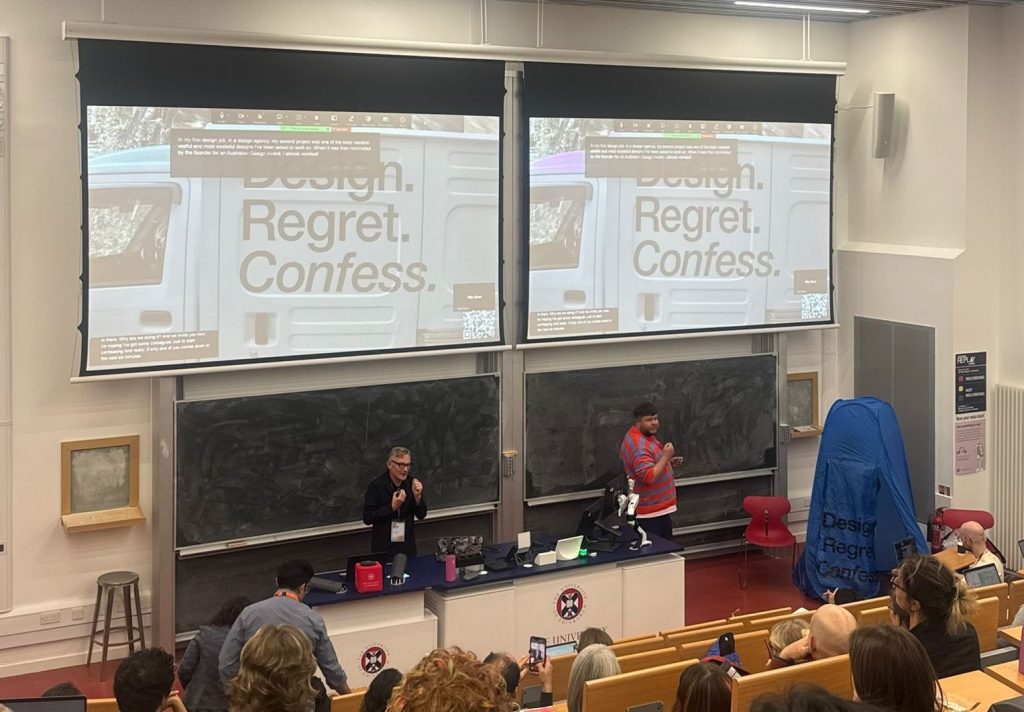
Design culture has proliferated aspirational value frameworks, from manifestos championing social justice to ethics toolkits, yet lacks meaningful accountability infrastructure when values are violated or conflict. This paper examines a transgressive design research intervention: a mobile confessional booth at a city Design Week in 2025 that invited designers to anonymously confess professional compromises and ethical failures. The 125 confessions revealed patterns of deflection (blaming systems over individual agency), superficiality (focusing on technical mistakes rather than methodological rigour leading to ethical violations), and conspicuous absence of admissions regarding exploitation, greenwashing, or designing harm. Unlike medicine, law, or journalism, design has implemented no meaningful ethical infrastructure, defaulting instead to personal intra-structuring of consequences for harmful or negligent practice. This structural gap means values remain aspirational rhetoric or private guilt, unable to be metabolised collectively. The paper argues value accountability requires bottom-up infrastructure to surface, negotiate, and reckon with complicity in design practice.
View Paper: https://doi.org/10.21606/drs.2026.944
Session Details:
PAPERS: Design as Care: Values and Accountability in Practice
Time: 10/June/2026: 4:00pm-5:30pm · Location: Appleton Tower, LT1
Making-with Biomaterials: Attuning to More-than-Human Temporalities in Growth and Decay Practices
Javier de Urquijo Isoard, Joshua Riesel
RMIT, Australia School of Design
This paper explores how design practices involving biomaterials can promote attuning within more-than-human temporalities. Drawing on two comparative case studies working with decomposing organisms to make and unmake materials, it examines how growth and decay unfold across different ecological timescales. Through concepts of noticing, pace, and rhythm, the studies explore how designers negotiate when to pause, accelerate, or distribute agency within multispecies collaborations. Rather than treating biomaterials as substitutes for synthetics, the paper positions them as temporal components of ecosystems shaped by humidity, temperature, and microbial diversity. Attuning emerges as a practice of more-than-human coordination and care. The findings contribute to temporal design discourse by testing theoretical promises against the pressures of practice, revealing tensions that scholarly discussion alone cannot anticipate. The paper proposes rhythm and pace as practical navigational tools through which designers can communicate ecological temporalities to clients and position themselves as facilitators of more-than-human processes.
View Paper: https://doi.org/10.21606/drs.2026.1628
Session Details:
PAPERS: Temporalities of More-than-Human Design
Time: 11/June/2026: 9:00am-10:30am · Location: Appleton Tower, LT4
accessibility: https://www.accessable.co.uk/the-university-of-edinburgh/central-area/access-guides/appleton-lecture-theatre-4-edinburgh
Three lenses, one wicked problem: Navigating pluralism to address consumer confusion in Australia
Brian Rodrigo Llagas1,3, Linda Brennan1,3, Simon Lockrey2,3
1School of Media and Communication, RMIT University, Building 9, Level 4, 124 Latrobe Street, Melbourne, Victoria, 3001 Australia; 2School of Design, RMIT University, Building 9, Level 5, 124 Latrobe Street, Melbourne, Victoria, 3001 Australia; 3End Food Waste Cooperative Research Centre, Wine Innovation Central Building, Level 1, Waite Campus, Urrbrae, South Australia, 5064 Australia
Food waste presents a significant global environmental and economic challenge. Australian households are responsible for 40% of discarded food, with unclear date labelling and storage advice creating consumer confusion, contributing to the problem. This research employed systems thinking and pluralism to address consumer confusion. A multi-level analytical framework integrating visual grammar, symbolic interactionism, and activity theory examined semiotic dimensions, interactions, and system behaviours within the food packaging system. Micro-level prototyping generated design concepts for date labels and storage advice. Meso-level collective intelligence-participatory design techniques evaluated the designs and brainstormed solutions. Scenario planning at the macro level used morphological analysis to generate insights and develop future scenarios. Findings reveal misaligned activity systems among consumers (assess), industry (communicate), and policymakers (regulate), highlighting the need for system-wide collaborative design rather than policy alone. This pluralist approach offers a replicable framework for tackling wicked design problems beyond food waste.
View Paper: https://doi.org/10.21606/drs.2026.1156
Session Details:
PAPERS: Methods in the Wild: Tools and Frameworks for Navigating Complexity
Time: 11/June/2026: 9:00am-10:30am · Location: Appleton Tower, LT5
Accessibility: https://www.accessable.co.uk/the-university-of-edinburgh/central-area/access-guides/appleton-lecture-theatre-5-edinburgh
Đồng-design: Designing togetherness as a systemic approach to Vietnam’s textile and apparel transformation
Lan Lam, Donna Cleveland
RMIT International University
Vietnam’s textile and apparel industry, one of the world’s largest garment exporters, is under growing pressure to shift from labour-based to design-led and sustainable business models. However, applying Western co-design frameworks within the hierarchical and production-driven context of large enterprises reveals significant cultural and structural constraints. Drawing on in-depth interviews and reflexive journaling, this paper reports findings from two phases of an ongoing project and examine how design participation is understood and enacted across Vietnam’s fashion eco-system, contrasting the relational practices of micro and small enterprises with the fragmented processes of large manufacturers. It introduces đồng-design, a culturally situated approach grounded in the Vietnamese value of togetherness, as a systemic way of designing collaboration across scales. By articulating đồng-design as both a conceptual and practical framework, the study contributes to pluralistic understandings of systemic design and highlights pathways for building design capacity and collaborative agency.
View Paper: https://doi.org/10.21606/drs.2026.1826
Session Details:
PAPERS: Rooted and Reaching: Situated Practice, Pedagogies, and Futures
Time: 11/June/2026: 2:00pm-3:30pm · Location: Appleton Tower, LT5
Accessibility: https://www.accessable.co.uk/the-university-of-edinburgh/central-area/access-guides/appleton-lecture-theatre-5-edinburgh
Related posts
Cooperation, or the Lack of It
Two events I attended recently, on the surface, have almost nothing in common — one was an exhibitio...

Staying in the Aporia
Augustine, writing to God in Book XI of the Confessions, admits he doesn’t know what time is....
Pirate DRS 2026
Thank you to all the speakers who survived the onslaught of “walk the plank”, “pir...
Data Otherwise
Data Otherwise: More-than-Human Data Practices at DRS 2026 What if the problem with data isn’t...
Making Knowledge, Fragmenting Certainty
Friday 22nd, 2026 at Monash, design researchers presented artifacts from their practice—Jon McCormac...
YOU ARE NOT FEEDSTOCK
Last week at The Capitol Melbourne, we launched the RMIT Regenerative Futures Institute. I want to t...
What Doesn’t Need To Be New: Two Launches, One Week, One Paradox
Last week brought two events exploring regenerative futures from very different angles. On one after...

What does it mean for a university to be alive?
The RSA (The royal society for arts, manufactures and commerce), RMIT’s Regenerative Futures I...
Launching RFI…!
Universities are extraordinarily good at adding things. Sustainability offices. Innovation hubs. Int...
Three provocations on designing futures worth watching / reflecting…
Over recent weeks, we’ve been hosting talks from visitors who come through Melbourne. Always fun to...
What Would It Take to Read the Label?
February’s Futures Collider at RFI put three provocations in a room and asked people to act ou...
What Gets Counted When Institutions Choose Speed
Two Sessions at FACT 2026 Reflections on qualitative knowledge, AI efficiency pressures, and what ge...
Two Rooms, Two Temporalities
Two events at RMIT over the past couple of weeks revisited the temporal challenges at the heart of h...

Temporal Traps
Ending the year between collapse and care: three December gatherings on time, action, and giving bac...

Notes toward the 6th finger
I’ve spent 20 years watching designers optimise products that score well environmentally while...

Rep / Non-Rep & Foreclosure
Catching up with things, and the first of two posts this week, reflecting on events last week. Stayi...